Our Verdict
The right speaker cable will not change your system's character, but it will allow it to perform at its full potential. Conductor quality, geometry, gauge, and termination all play a role: matching these to your system and room is the key to getting it right.
Quick Take
- Speaker cables carry a high-current analogue signal: resistance, capacitance, and inductance all influence timing, bass control, and tonal balance.
- OFC copper is the standard conductor. Silver-plated copper and solid silver improve detail and transparency at higher price points.
- For runs up to 3 metres, 14 to 16 AWG (1.5 to 2.5mm²) is suitable. Longer runs benefit from 12 AWG (3mm²+) to limit resistance.
- Bi-wiring can improve clarity and separation if your speakers and amplifier support it. Bi-amping goes further, with separate amplifiers driving each section.
- Budget around 5 to 10% of your total system cost on speaker cables, and allow 50 to 100 hours of burn-in for the cable to stabilise electrically.
- Keep cables away from mains leads and digital cables, avoid tight coils, and use equal lengths for both channels to preserve stereo imaging.
Speaker cables are the lifeline of your hi-fi system, carrying the amplified signal from your amplifier to your loudspeakers. While they might seem simple, the design, materials, and connections used in speaker cables can significantly influence sound quality. Whether you're setting up your first system or fine-tuning a high-end setup, understanding the fundamentals of speaker cabling ensures every note reaches your speakers as intended.
What Do Speaker Cables Do?
A speaker cable transmits a high-current analogue signal between your amplifier and speakers. Unlike interconnects, which carry low-level signals, speaker cables must deliver power efficiently while maintaining clarity and dynamics. Any resistance, capacitance, or inductance within the cable can subtly shape the sound, particularly in terms of timing, bass control, and tonal balance.
Key Design Factors
Conductor Material
Most speaker cables use oxygen-free copper (OFC) for its excellent conductivity. Premium designs may feature silver-plated copper or solid silver for improved detail and transparency. The purity and structure of the metal influence resistance and signal integrity.
Cable Geometry
How the conductors are arranged affects inductance and capacitance. Twisted pairs, multi-stranded layouts, and proprietary geometries (such as Chord Company's ARAY or AudioQuest's Zero Tech designs) are engineered to reduce interference and preserve timing accuracy.
Insulation and Dielectric
The dielectric separates the conductors and can store electrical energy, impacting transient performance. Materials like polyethylene (PE), Teflon (PTFE), and foamed dielectrics are preferred for their low capacitance and consistent impedance.
Shielding
While speaker cables typically carry strong signals that resist noise, shielding can still be beneficial in electrically noisy environments, especially near mains cables or wireless transmitters.
Connectors
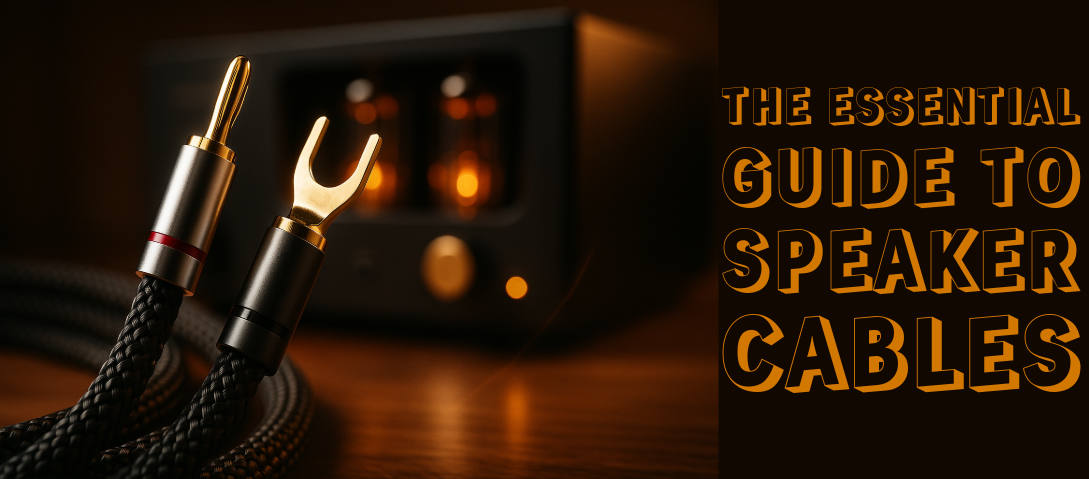
Good terminations ensure a stable, low-resistance connection. The most common types are:
- Banana plugs: quick to connect, ideal for frequent changes.
- Spade connectors: provide a secure, wide-area contact for tight binding posts.
- Bare wire: effective but more prone to oxidation over time.
High-quality connectors (gold or rhodium-plated) prevent corrosion and maintain a clean signal path. You can browse speaker cable plugs separately if you need to re-terminate existing cables.
Single-Wire, Bi-Wire and Bi-Amping Explained
Single-Wire
Most systems use a single run of cable per channel, linking the amplifier's output to the speaker's binding posts. If your speakers have twin terminals, metal jumpers connect the high and low-frequency sections.
Bi-Wire
Bi-wiring uses two separate conductors within the same cable (or two runs) to feed the tweeter and woofer sections individually. The goal is to reduce interference between high and low frequencies, improving clarity and separation.
Bi-Amping
In bi-amping setups, separate amplifiers drive each section of the speaker, offering increased control and headroom. This configuration benefits from matched cable runs to maintain timing coherence.
Cable Length, Gauge and Resistance
Cable length affects resistance, and resistance impacts how efficiently your amplifier controls your speakers. As a rule:
- Keep cables as short as practical while allowing enough slack for neat routing.
- For runs up to 3 metres, 14-16 AWG (1.5-2.5mm²) is suitable.
- For longer runs, 12 AWG (3mm²+) is recommended.
Avoid coiling excess cable, as this can introduce unwanted inductance.
Matching Cables to Your System
- System balance: Choose a cable that complements your components. Brighter systems often benefit from warmer-sounding cables, while darker systems pair well with more revealing designs.
- Consistency: Using the same brand or series of cables throughout your system maintains tonal consistency.
- Budget allocation: Allocate around 5-10% of your total system cost to speaker cables as a rule of thumb.
- Build quality: Look for solid connectors, durable insulation, and flexibility for easy installation.
- Burn-in period: Many audiophiles notice subtle improvements after 50-100 hours as the cable stabilises electrically. FutureShop offers a free cable burn-in service on all speaker cables supplied by us.
Which Brand Suits Your System?
The article above explains how to choose a speaker cable in principle. The more practical question is which of the brands in our range best suits your specific system and listening priorities. Here is FutureShop's brand-level guide, drawn from two decades of recommending speaker cables across a wide range of customer systems.
QED: transparency, value, and measured performance: QED has been making cables since 1973 and is one of the longest-established names in British hi-fi cable design. Their cables are known for a technically rigorous approach: detailed, transparent, and clean, with strong value at every price point. QED suits systems where clarity and resolution are priorities and where the amplifier already has a warm or musical character that can absorb the cable's transparency without tipping into brightness. The QED Performance series is the strongest value proposition in the range; the Silver Anniversary XT is the most consistently recommended upgrade from entry level. Our QED Golden Anniversary XT review covers the upper mid-range in detail.
Chord Company: resolution, imaging, and soundstage: Chord Company was formed in 1985 in Salisbury and occupies the upper end of the British cable market. Their cables are known for high-resolution detail, excellent stereo imaging, and a soundstage that reveals what your source components are capable of. Chord Company suits systems where resolution and spatial presentation are priorities and where the system has sufficient quality to reveal the difference. The Leyline and RumourX are the most accessible entry points; the Signature and Epic sit in the serious mid-range; the Sarum T and Music are regarded as reference quality. For a detailed comparison of Chord Company against QED and Atlas at the mid-range, our guide to Atlas vs QED vs Chord Company covers the differences in character, approach, and value.
Atlas: timing, rhythm, and musical flow: Atlas Cables was founded in Glasgow in 1997 and designs cables with a focus on conductor purity, low inductance geometry, and in-house cold-weld termination. Atlas cables are known for a neutral-to-warm sound with strong timing and rhythmic drive. They are particularly well regarded with British amplifiers and speakers, where timing and musical flow tend to be valued alongside outright resolution. The Equator is the value sweet spot at entry level; the Hyper is the most commonly recommended mid-range step up. Atlas is the most consistent FutureShop recommendation for Naim, Linn, and Rega systems, where its timing character reinforces rather than compromises the amplifier's natural strengths. The full Atlas guide is available separately.
AudioQuest: precision, detail, and system building: AudioQuest is an American brand founded in California in 1980, whose cables are designed around solid conductor geometry, careful noise dissipation, and the ZERO-Tech noise cancellation used in the higher ranges. AudioQuest speaker cables suit listeners who value precision and low-level detail, and who are building a system around AudioQuest throughout (speaker, interconnect, and digital cables from the same brand produce a particularly coherent presentation). The Rocket 11 is the most accessible entry point; the Type 5 and above introduce the solid PSC+ conductors and DBS packs that characterise the upper range. For a detailed account of how AudioQuest cables perform in practice across their range, our AudioQuest Netherlands visit Part 1 covers a side-by-side listening session from X2 through to Robin Hood ZERO.
Tellurium Q: phase accuracy and natural tonality: Tellurium Q is a British manufacturer founded in Somerset whose cable design is based on minimising phase distortion rather than simply optimising resistance and capacitance. The result is a cable that many listeners describe as natural and effortless, with a presentation that avoids electronic hardness. Tellurium Q suits systems where the listener wants a cable that removes character rather than adds it, and where the amplifier and speakers are already capable of revealing fine low-level detail. The Black II is the most frequently recommended starting point; the Ultra Black II is the step up for more resolving systems.
Common Questions About Speaker Cables
Do expensive speaker cables really sound better?
Often, the improvement comes from better materials, shielding, and lower resistance, not just price. The difference is more apparent in resolving systems.
What's the difference between banana plugs and spades?
Banana plugs are quick and convenient, while spades create a more secure physical connection. The choice often depends on your amplifier and speaker terminals.
Should both cables be the same length?
Yes, even if one speaker is closer to the amp. Equal lengths maintain identical electrical characteristics and stereo imaging.
Is it worth bi-wiring my speakers?
If your speakers and amplifier support it, bi-wiring can subtly enhance clarity and reduce distortion, though the benefit varies by design.
How should I route speaker cables?
Keep them away from mains leads, power strips, and digital cables to minimise noise pickup. Gentle curves are preferable to tight bends.
Summary
Speaker cables might look simple, but their influence on system performance is undeniable. From conductor design to terminations, every detail plays a role in how faithfully music is reproduced. The right cable won't change your system's character but will allow it to perform at its full potential.
Explore our full range of speaker cables, from single-wire and bi-wire designs to pre-terminated and custom options from leading brands like QED, Chord Company, AudioQuest, Atlas, and Tellurium Q.
For a broader look at how speaker cables fit into a full system upgrade, our Upgrading Your Hi-Fi System guide series covers every stage from source to room acoustics. If you would like to see how these principles apply in practice, our Merlin Tarantula Speaker Cable review is a good starting point for budget-to-mid-range cable comparisons.
Browse our full range of speaker cables, all backed by our 60-day money-back guarantee. Not sure which cable suits your system? Get in touch with our team for free expert advice.