FutureShop has been supplying audiophile-grade cables and hi-fi accessories since 2005, and mains power cables have been one of the most discussed categories in our showroom throughout that time. The observations in this guide draw on two decades of listening sessions with customers across a wide range of systems and listening environments.
Our Verdict
Mains power cables can make a meaningful, audible difference in many hi-fi systems, particularly those built around quality components in environments with noisy mains supplies, but the size of the effect depends on your system, your room, and your mains environment.
Quick Take
- Mains cables can make an audible difference but only in the right system and environment
- The mechanism is RF noise reduction, not voltage regulation
- Effects are typically refinement-based: lower noise floor, improved clarity, better detail retrieval
- Most impact on high-quality DACs, valve amplifiers, and systems in noisy mains environments
- Start with a single cable on your amplifier or DAC, and use FutureShop's 60-day guarantee to evaluate at no risk
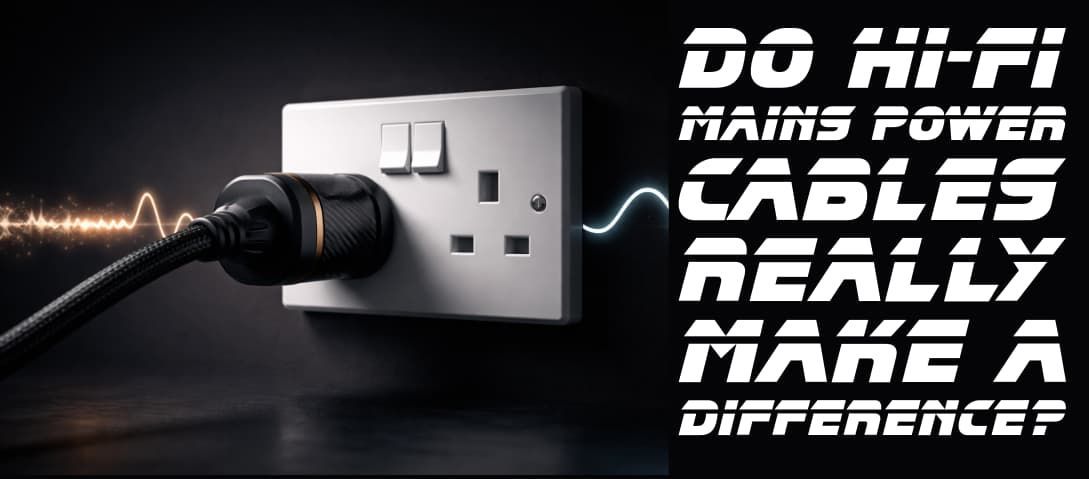
Few topics in hi-fi generate more heat and less light than mains power cables. Critics argue that a cable carrying 50Hz AC current cannot possibly affect the sound of audio equipment. Believers insist the improvements are among the most significant they have experienced. Both sides frequently talk past each other. This article tries to cut through the noise and give you a clear, honest picture of what is actually happening and when a mains cable upgrade is genuinely worth considering.
The Sceptic's Argument
The case against mains cables improving sound quality goes roughly like this. Your hi-fi component has an internal power supply. That power supply converts the mains AC into the DC voltages the circuitry needs. It also filters the incoming supply. What arrives at the cable connector is substantially transformed before it reaches the sensitive circuitry inside. Therefore, the cable itself cannot make a meaningful difference.
This argument is coherent and not without merit. In basic terms, it is correct that the power supply does a lot of work. For some components, particularly those with large, well-designed power supplies, the argument holds up reasonably well in practice.
Why the Argument Is Incomplete
The problem is that it assumes internal power supplies are perfect filters, and they are not. The job of a power supply is to regulate voltage and convert AC to DC. Filtering incoming RF noise is a secondary function, and it is one that many power supplies handle imperfectly.
High-frequency RF interference, which sits well above the 50Hz mains frequency, can pass through some power supply designs more easily than others. Once inside the component, this noise can affect the performance of sensitive analogue stages, DAC chips, clock circuits, and output stages. The effect is typically heard as a slightly hazy or grainy quality to the sound, or as a higher noise floor that obscures fine detail.
The mains cable is the first line of defence against this incoming noise. A cable with good noise-dissipation geometry and quality connectors can reduce the amount of RF that reaches the power supply in the first place, making the power supply's job easier and allowing the component to perform closer to its potential.
What the Evidence Shows
Controlled listening tests on mains cables are difficult to conduct properly. Double-blind testing of mains cables requires swapping cables while maintaining identical conditions, which is harder than it sounds and rarely done rigorously. The published studies that do exist are inconclusive, partly because they often use modest equipment that may not reveal the differences.
However, there is a large body of consistent reports from experienced listeners, reviewers with decades of experience, and professional recording engineers who use mains cables in studio environments where performance is not a lifestyle choice but a practical requirement. The consistency of these reports, across different systems, different rooms, and different cables, suggests something real is happening.
When a Mains Cable Is Most Likely to Make a Difference
The impact of a mains cable upgrade is not equal across all systems. There are conditions that make a difference more likely and more audible.
| Factor | More likely to hear a difference | Less likely to hear a difference |
|---|---|---|
| Component quality | High-quality DAC, valve amplifier, sensitive clock circuits | Budget amplifier with a simple internal power supply |
| Mains environment | Older wiring, near industrial premises, many switching supplies on same ring main | Modern dedicated mains circuit with little local interference |
| System resolution | Resolving system with a low noise floor that reveals fine detail | System that already masks small differences in source quality |
| Cable quality | Designed noise-dissipation geometry, quality IEC and mains plug connectors | Standard OEM cable supplied with the component |
Component quality matters. A budget amplifier with a simple power supply may not reveal the benefits of a quality mains cable. A high-quality DAC with a sensitive clock circuit, or a valve amplifier with a large power supply that draws heavily on the mains, is more likely to respond to an improvement in power quality.
Your mains environment also plays a role. Properties with older wiring, those close to industrial premises, or those with a lot of switching power supplies on the same ring main, often have noisier mains supplies. In these environments, the benefit of a quality mains cable is more pronounced.
Finally, system resolution matters. A system that already reveals fine detail and has a low noise floor will show the effects of a power cable change more clearly than a system that masks small differences.
Starting With One Cable
If you are new to mains cable upgrades, the practical approach is to start with a single cable on the component you consider most critical. For most people this is the amplifier or the DAC. Try it for a few weeks, give it time to run in, and then assess honestly. If you hear a clear improvement, you have your answer. If you hear nothing, the cable can go back within FutureShop's 60-day money-back guarantee window.
This is a lower-risk approach to finding out whether mains cables make a difference in your specific system than any amount of online debate.
Among the cables we recommend most frequently at this starting point are IsoTek, Supra, and Merlin at the accessible end of the range, with AudioQuest and Furutech offering significant steps up for more demanding systems.
Which Component Should You Start With, and Which Cable?
Knowing that a mains cable can make a difference is one thing. Knowing which component to plug it into first, and which cable to choose, is the more practical question. Here is FutureShop's component-by-component guidance based on two decades of customer listening sessions.
DAC or digital source (streamer, CD transport, network player): This is consistently the component where a mains cable upgrade produces the most audible result for the price. Digital components rely on precise clock circuits, and RF noise riding in on the mains supply is known to cause jitter and raise the noise floor at the DAC output. The improvement is typically heard as a cleaner, more focused presentation with better low-level detail. Even a modest cable such as the IsoTek EVO3 Initium on a mid-range DAC or streamer frequently produces a clearly audible result. If your system has only one quality mains cable, put it here first.
Integrated amplifier: The amplifier draws the most current in any system and typically has the largest transformer in the power supply. A well-designed internal power supply handles a lot of filtering, but in amplifiers with less sophisticated power supplies, or those near the budget end of a manufacturer's range, a quality mains cable can reduce the noise floor and improve dynamics. Valve amplifiers are particularly responsive because they are sensitive to mains quality. The Supra LoRad range is a frequently recommended starting point for integrated amplifiers, balancing noise reduction with adequate current delivery for high-draw components.
Phono stage: A phono stage amplifies the cartridge signal by up to 1,000 times, making it the most gain-sensitive component in a turntable-based system. Any noise in the mains supply is amplified alongside the music signal. The effect is typically heard as background hiss or a slightly grainy quality to quiet passages. A quality mains cable on the phono stage is a high-impact, low-cost upgrade for vinyl listeners. Merlin and IsoTek cables both work well here, and a modest investment at this point can produce a noticeable improvement even in systems where the phono stage is the budget end of the chain.
Preamplifier (in separates systems): In a pre-power system, the preamplifier is worth addressing before the power amplifier. The preamp handles the lowest signal levels in the chain and is where noise has the most audible impact. A power amplifier's internal power supply is generally more robust and less sensitive to mains quality than the preamp's. AudioQuest NRG-Y3 or NRG-Z3 cables are our most frequent recommendation for separates preamps, where the step up from the OEM cable is consistently audible in the improved clarity of the midrange.
Power amplifier: Power amplifiers are the last priority in most systems. They draw the most current but their sheer power supply size and the fact that they handle already-amplified signals makes them the least sensitive link in the chain to mains cable quality. That said, in very high-end systems where every element has been optimised, a quality power cable on the power amplifier does contribute. Furutech cables are frequently recommended for power amplifiers, as their robust construction and high current capacity suit the demands of a high-draw component.
Power conditioner or distribution block: If you are using a mains conditioner or a quality distribution block, the cable feeding it is the single most important mains cable in the system, as it affects everything downstream. A quality cable at this point is more cost-effective than individual cables on each component. AudioQuest and Furutech both produce cables well suited to this application, with the cable's performance setting the ceiling for everything the conditioner can deliver downstream.
The Bottom Line
Mains power cables can and do make a difference in many systems, particularly those built around quality components in environments with noisy mains supplies. The effect is not guaranteed, and it is not always large. But the consistency of the evidence from experienced listeners, combined with a plausible physical explanation, makes mains cable upgrades worth investigating rather than dismissing.
For a broader look at power and grounding as part of a full system upgrade, see our guides on upgrading your hi-fi system's power and grounding, our comprehensive power cable guide, and the Shunyata Research Alpha and Omega power cord review for a detailed look at what a serious power cable upgrade sounds like in practice.
Our full range of hi-fi mains power cables, including AudioQuest, Furutech, IsoTek, Merlin, and Supra, is available now at FutureShop, backed by our 60-day money-back guarantee on cables. If you want to go further, explore our power conditioners and power blocks for a more complete approach to mains quality. Not sure where to start? Get in touch with our team. We've been helping customers find the right power cable for their system since 2005 and are happy to advise.