This guide was written by Phillip Powell, who has over 15 years of experience advising customers on hi-fi system upgrades at FutureShop. We stock a curated range of specialist hi-fi fuses alongside mains cables, power blocks, and power conditioning products.
Our Verdict
In entry-level and mid-range systems, a fuse upgrade is unlikely to be the most productive investment. In a well-developed, resolving system with clean mains infrastructure, it can contribute a worthwhile refinement. Safety always comes first: always match the exact fuse rating and never increase it.
Quick Take
- A fuse sits directly in the mains power path of a component: every bit of current entering the device passes through it
- Reported improvements are typically subtle: cleaner background silence, slightly more open highs, better micro-detail. Not dramatic transformations
- The more resolving your system, the more sensitive it is to small upstream changes. Fuse upgrades belong in the optimisation category, not the upgrade category
- In entry-level systems or rooms with significant acoustic problems, a fuse is unlikely to be the limiting factor
- In a well-developed system with good mains infrastructure, a fuse upgrade can be part of the final polish
- Safety is non-negotiable: always match the exact rating (T or F, correct amperage) and never increase it
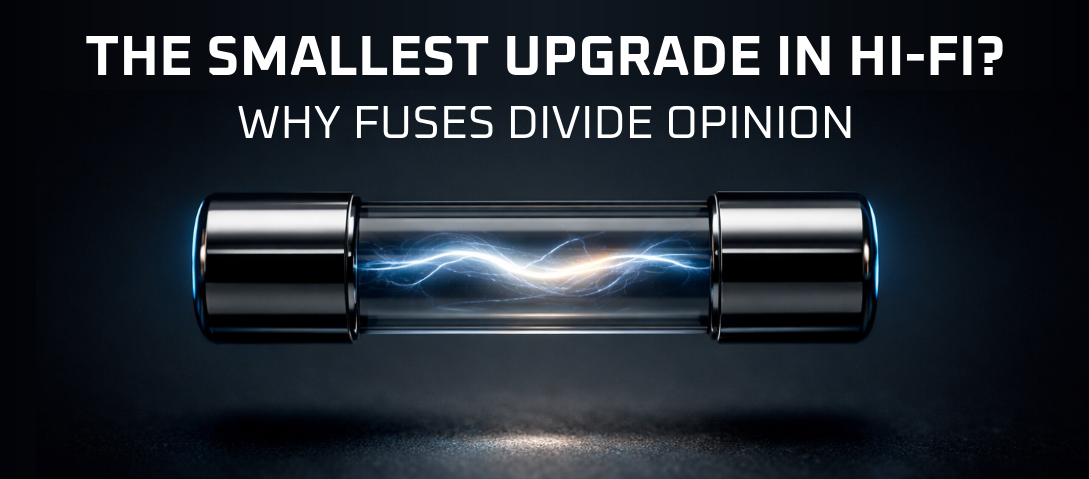
Few upgrades in hi-fi spark as much debate as the humble fuse.
For some listeners, upgrading a fuse brings improved clarity, refinement and a lower noise floor. For others, the idea seems implausible. How could such a small component influence sound quality at all?
So why does this tiny part generate such strong opinions?
The answer lies in how power flows through your system, how resolving your equipment is, and how we interpret subtle changes in sound.
What a Fuse Actually Does
A fuse is a safety device. Its primary role is to protect equipment by breaking the circuit if excessive current flows.
In most amplifiers, DACs and power supplies, the fuse sits directly in the mains power path. That means every bit of current entering the component passes through it.
From a purely electrical standpoint, a fuse:
- Has measurable resistance
- Creates a physical contact point at both ends
- Sits before the internal power supply regulation
It is not part of the audio signal path, but it is part of the power delivery chain. And power quality matters.
Why Some Listeners Hear a Difference
Those who report improvements often describe:
- Cleaner background silence
- Slightly more open high frequencies
- Better micro-detail
- More stable imaging
These are not dramatic "night and day" changes. They are typically subtle refinements.
The reasoning usually centres on:
- Contact quality at the fuse caps
- Material conductivity
- Reduced micro-arcing at contact points
- Improved mechanical stability
In highly resolving systems, particularly with revealing speakers and clean mains power, even small reductions in noise can be audible.
Why Others Remain Sceptical
The scepticism is understandable.
Compared to upgrading speakers, room treatment or amplification, a fuse is a very small component. Its measurable electrical differences are tiny.
Many listeners will never hear a difference, especially in:
- Entry-level systems
- Rooms with significant acoustic issues
- Systems where larger bottlenecks exist
In these cases, the fuse simply isn't the limiting factor. And that's where context matters.
Resolution Scaling: The Key Factor
One of the most important ideas in hi-fi is resolution scaling.
The more revealing and transparent your system becomes, the more sensitive it is to small changes upstream.
In modest systems, major upgrades bring the biggest improvements. In refined systems, the gains become incremental, and that's where tweaks such as isolation, power conditioning and fuses enter the picture.
A fuse upgrade rarely transforms a system. But in the right environment, it can fine-tune one.
Why Fuses Trigger Strong Reactions
Fuses generate debate for a few key reasons, of which cost is one of them.
They Span a Huge Price Range
Unlike a standard replacement fuse, specialist hi-fi fuses can range from modest upgrades to serious investments. In some systems, a fuse may cost more than an entry-level amplifier.
That alone raises expectations and scrutiny.
When customers invest in premium fuses, they understandably expect meaningful results. And in highly resolving systems, the impact can be far from trivial.
The Results Can Vary Dramatically by System
In some systems, a fuse upgrade may bring subtle refinements: slightly improved separation, lower perceived noise, or more focus in the soundstage.
In others, particularly revealing, high-current systems with clean mains infrastructure, the change can be noticeably more pronounced. Dynamics can feel freer, bass more articulate, and presentation more open.
System synergy plays a decisive role.
They Sit in the Power Chain
Unlike isolation tweaks or cable dressing, a fuse sits directly in the incoming power path of a component.
For those who believe power delivery is fundamental to system performance, that positioning makes intuitive sense.
For those who see a fuse purely as a protection device, it seems implausible that it could influence sound.
Both viewpoints stem from different starting assumptions about how power affects audio performance.
Expectations Are Higher at This Level
When you reach the stage of considering fuse upgrades, you're typically refining an already capable system.
At that point, changes are less about transformation and more about extracting the last layer of performance. Some listeners value that last 5-10%. Others prioritise larger-scale upgrades.
That difference in philosophy is often what drives the strongest opinions.
When a Fuse Upgrade Makes Sense
While a fuse may not always be the first port of call, we often recommend addressing power early in a system's development.
That can include:
- Upgrading mains cables
- Introducing a quality power block
- Improving power conditioning
- Optimising the overall mains distribution
Fuses sit within that same power chain. They are not separate from it, they are part of it.
In many cases, customers considering fuse upgrades already have well-developed systems. They've addressed speakers, room positioning, core electronics and cabling, and are now refining performance.
However, that isn't always the rule.
There are situations where upgrading a fuse can bring a greater improvement than replacing an already strong-performing component. If a system is fundamentally sound but constrained by power delivery, optimising that chain can unlock performance more effectively than a sideways component move.
As with any upgrade, context is everything. The goal is not to follow a rigid hierarchy, it's to identify where the bottleneck truly sits.
Safety Always Comes First
One thing that should never be debated is safety.
If replacing a fuse:
- Always match the exact rating (T or F, correct amperage)
- Never increase the rating
- Follow manufacturer guidance
- Ensure proper installation
A fuse is first and foremost a protection device. Sound quality should never compromise safety.
A Practical Guide to Choosing and Fitting a Hi-Fi Fuse
If you have decided a fuse upgrade is appropriate for your system, the practical questions are: which component to start with, how to find the correct specification, and which fuse to choose. Here is FutureShop's component-by-component guidance.
Which component should you fuse first? The component that draws the most current and has the largest transformer is usually the amplifier, and it is the most common starting point for fuse upgrades. However, for listeners whose primary interest is digital sources, the DAC is often the more productive first step, for the same reason it is the most productive starting point for mains cable upgrades: its clock circuits and output stages are sensitive to fine changes in power quality. In practice, the amplifier is the right first choice for analogue or vinyl-focused systems; the DAC is the right first choice for streaming and digital-source systems.
How to identify the correct fuse specification. Every component that uses a fuse will have the specification printed on the fuse holder, on the rear panel near the IEC socket, or in the owner's manual. The three critical parameters are: size (typically 5x20mm for most European components, or 6.3x32mm for some American designs), type (T for time-delayed/slow-blow, F for fast-blow), and amperage (the current rating, printed on the fuse). You must match all three. Never substitute a fast-blow fuse for a slow-blow or vice versa, as this can cause the fuse to blow prematurely or, in the case of fitting a slow-blow where a fast-blow is specified, fail to protect the component correctly in a fault condition.
What the hi-fi fuse brands in our range offer. FutureShop stocks a curated selection of specialist hi-fi fuses from manufacturers who have specifically engineered their products for audio applications. The distinguishing features across the range include higher-purity conductor elements (typically silver or silver alloy rather than the zinc or alloy used in standard fuses), tighter-tolerance end caps for better contact with the fuse holder, and in some cases, internal dampening to reduce microphonic resonance. The claimed mechanism for sonic improvement is the same as for quality mains cables: reduced contact resistance and lower noise at the point where power enters the component.
Directionality. Some hi-fi fuse manufacturers specify a preferred direction of installation, marked by an arrow or a text label on the fuse body. The rationale is the same as for directional audio cables: the internal element has been conditioned in a particular direction during manufacture. Whether this is audible is a matter of ongoing debate, but if a direction is marked, it costs nothing to follow it.
Run-in time. As with mains cables and other power products, most fuse manufacturers recommend a run-in period before final evaluation. This is typically 50-100 hours of normal use. Evaluating a new fuse within the first few hours of installation and concluding it has made no difference is not a reliable assessment.
The Real Answer: It Depends on the System
Hi-fi fuses divide opinion because systems differ. Listening priorities differ. Rooms differ.
There is no universal answer.
In some systems, the difference may be negligible. In others, it can bring a small but worthwhile refinement that contributes to overall musical coherence.
The key is understanding where you are in your upgrade journey.
Final Thoughts
Hi-fi is not only about major upgrades. It is also about optimisation.
Fuses sit firmly in the optimisation category.
They are not magic. They are not a shortcut to system transformation. But in resolving systems with carefully considered power infrastructure, they can be part of the final polish.
And that's why they continue to spark discussion.
If you are thinking about the broader power picture in your system, our guide Do Hi-Fi Mains Power Cables Really Make a Difference? covers the same question for mains cables, and is a useful companion read for anyone working through power optimisation.
Browse our range of specialist hi-fi fuses at FutureShop, alongside mains power cables, power blocks, and power conditioners. Not sure where to start with your power chain? Get in touch with our team. With over 15 years advising customers on system optimisation, we are happy to help.