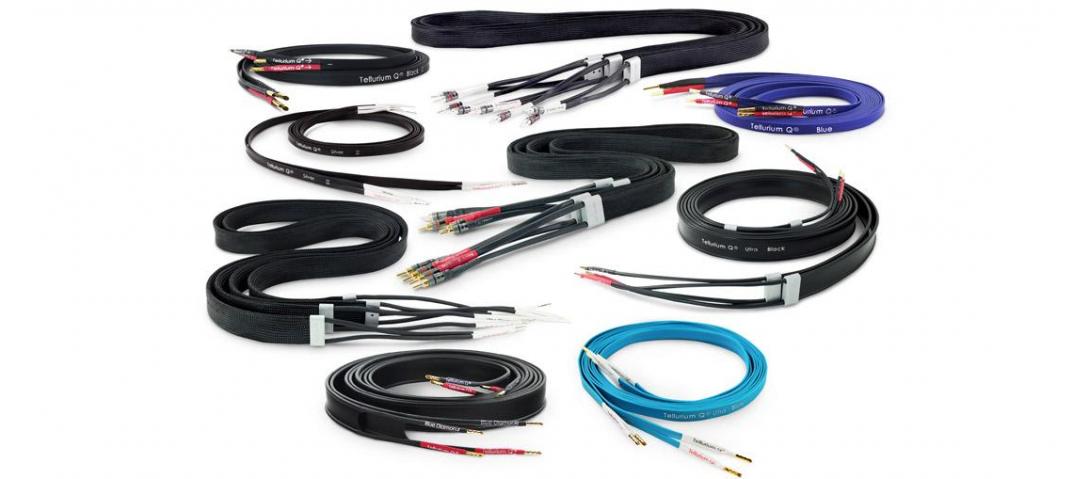
FutureShop is an authorised dealer for AudioQuest, QED, Tellurium Q, Chord Company, Nordost, and Atlas Cables. All speaker cables are available in custom lengths, terminated to order, with our free Nordost Vidar burn-in service and 60-day money-back guarantee.
The Short Version
Speaker cables are the final link in the signal chain between your amplifier and your speakers. Every quality, design choice, and engineering decision in a speaker cable affects how accurately the amplifier's signal reaches the speaker driver. A quality cable does not add anything to the signal; it loses less of it. This guide explains the specific technical reasons why better cables perform better, and what to look for when choosing one.
Quick Take: What Makes a Speaker Cable Better
- Conductor material and purity: High-purity copper (OFC, OCC) reduces resistance and minimises the distortion that impurities in the conductor introduce. Silver-plated conductors improve high-frequency transmission. Neither material is universally better: the right choice depends on the character of your system.
- Conductor configuration: Solid conductors eliminate strand interaction distortion. Twisted pair geometry reduces proximity effect. Hollow tube designs (X-Tube) spread conductors to address the skin effect. Each approach has a different sonic character.
- Dielectric: The insulation material absorbs and releases energy from the conductor, affecting timing and detail. Better dielectrics (foamed polyethylene, Teflon/PTFE, air-core designs) reduce this effect.
- Shielding: Protects the signal from external EMI. More important in electrically noisy environments and for cables running near power cables.
- Connectors: The plug material, plating, and termination method affect signal transfer at the connection point. Cold-weld and solder-free terminations outperform screwed connections over time.
- Length: Resistance increases with cable length. Both cables in a pair should be the same length. The shortest run that is physically practical is generally preferable.
Why Speaker Cable Quality Matters
When a new amplifier or speaker system is purchased, speaker cables are often the last consideration. Most budget is spent on the components themselves, and a cheap cable is used to connect them. This is a mistake that limits the performance of everything else in the chain. Speaker cables carry the amplified signal from the amplifier output terminals to the speaker input. Any resistance, distortion, or signal loss in that connection directly reduces the fidelity of what the speaker produces.
Quality speaker cables are engineered to minimise these losses at every level. The following sections explain what each variable does and why it matters in practice.
Conductor Material and Purity
Copper is the most common conductor material in speaker cables because it combines high conductivity with reasonable cost. The purity of that copper matters: standard copper contains microscopic impurities at the grain boundaries where individual copper crystals meet. These boundaries introduce resistance and distortion at a fine level. Higher-purity copper addresses this: OFC (oxygen-free copper) removes dissolved oxygen; OCC (Ohno Continuous Cast) eliminates crystal grain boundaries entirely by casting in a single unbroken crystal. Both approaches reduce these distortions and produces a measurably cleaner signal path.
Silver-plated and silver conductors have higher conductivity than copper and handle high-frequency signals more effectively. In systems that sound warm or lacking in detail, silver-plated cables can add clarity and top-end resolution. In systems that already sound bright or clinical, a silver-heavy design may not be the right match. The choice between copper and silver is a system-matching decision, not a question of which metal is objectively better.
Conductor Configuration and Geometry
How the conductors are arranged within the cable affects both its electrical performance and its sonic character. The two main issues that conductor geometry addresses are the skin effect and proximity effect.
The skin effect describes the tendency of high-frequency signals to travel on the outer surface of a conductor rather than through its entire cross-section. In a standard round conductor, this means the outer surface carries the high-frequency content while the core carries lower frequencies, leading to phase differences between frequencies. QED's X-Tube technology wraps conductors around a hollow tube, spreading them over a much larger surface area and allowing high-frequency signals to travel evenly rather than concentrating at the outer edge. AudioQuest's semi-solid concentric designs address the same problem through a different geometric approach.
The proximity effect describes the mutual interference between adjacent conductors carrying opposing currents. Twisting the positive and negative conductors together (and in some designs, arranging multiple conductor pairs in specific geometric relationships) cancels the magnetic fields each conductor creates, reducing interference between them. Nordost's ribbon and flat cable geometry addresses this in a different way: by keeping conductors in a controlled parallel arrangement with precise spacing.
Dielectric and Insulation
The insulation surrounding a conductor performs two functions: it prevents electrical contact between conductors, and it determines how the conductor's electromagnetic field interacts with the surrounding material. The problem is that all insulation materials absorb some of the electrical energy from the conductor and release it back at a slightly different time, which introduces a subtle smearing of the signal.
Better dielectric materials absorb less energy. PVC is the cheapest and least effective. Polyethylene and foamed polyethylene are common in mid-level cables. PTFE (Teflon) is considered the best practical dielectric. Some manufacturers, including Nordost and QED, use air-core designs that replace the insulation between the conductor and the outer sheath with air, which is effectively a perfect dielectric. The improvement in timing, clarity, and musical coherence from better dielectrics is audible, and often accounts for a significant portion of the sonic difference between cables at different price levels from the same manufacturer using the same conductor.
Shielding
Speaker cables carry a strong signal from the amplifier and are therefore less susceptible to external interference than interconnects carrying a low-level phono or line-level signal. However, shielding still performs a useful function: it prevents the speaker cable's own magnetic field from inducing interference into adjacent signal cables. In a system where power and signal cables run in proximity, well-shielded speaker cables reduce the electromagnetic pollution that the speaker cable itself creates.
Braided copper shielding provides good coverage with reasonable flexibility. Foil shielding provides higher coverage but is less durable. Higher-end cables often combine both. In most domestic hi-fi setups, the improvement from speaker cable shielding is modest compared to interconnect shielding, but it remains worthwhile, particularly in electrically dense rack installations.
Connectors and Termination
The signal that travels the length of a speaker cable passes through the connector at each end. A poor-quality connector introduces resistance, oxidation, and mechanical instability at the connection point, undermining everything the cable itself achieves. This is why FutureShop terminates all speaker cables to order using the appropriate connector for the specific amplifier and speaker binding posts being used.
Connector material matters in the same way conductor material does: copper-core plugs with silver or gold plating provide better conductivity than nickel or composite alternatives. Gold resists oxidation over time and requires minimal maintenance. Silver is more conductive but requires periodic cleaning. The termination method matters too: cold-weld connections (such as Atlas's Integra system and QED's AIRLOC) create an airtight seal around the conductor that maintains contact quality over the lifetime of the cable. Soldered connections introduce different materials into the signal path. Screwed connections can loosen over time and are generally the least secure of the three methods.
Cable Length
Resistance in a speaker cable increases with length. Higher resistance means the amplifier must work harder to deliver current to the speaker, particularly at low frequencies where impedance is often lowest and current demand highest. For this reason, keeping speaker cables as short as the room allows is good practice. However, the most important length consideration is consistency: both cables in a stereo pair must be the same length. A significant length difference between left and right cables creates a small but measurable timing difference that affects the stereo image.
Our guide to speaker cable variables (Vol. 3) covers length guidance in detail, including the recommended minimum ratio between left and right cable lengths on asymmetric setups.
Speaker Cable Upgrade Path: Where to Start
The best speaker cable for your system depends on what your system already sounds like and what you want to change. The table below maps typical system character to a suggested upgrade direction and a starting point in FutureShop's range.
| Current situation | Upgrade direction | Where to start |
|---|---|---|
| Using supplied or budget cables. Any system level. | Any properly engineered OFC cable is a clear step up from generic cable. Start here before spending on electronics upgrades. | QED XT40i or AudioQuest Rocket 11 |
| Using an entry-level OFC cable. System sounds acceptable but lacks detail or sounds closed-in. | Move to a cable with skin-effect and proximity-effect management. The improvement in soundstage and high-frequency clarity is typically significant. | QED Golden Anniversary XT |
| Using a quality mid-range cable. System sounds good but timing feels slightly loose or music lacks involvement. | Consider a cable with a different design philosophy targeting phase distortion. This is a character change rather than a specification step-up. | Tellurium Q Black |
| Using a reference cable. Want to understand what the next tier delivers before committing. | Contact our team for a system-specific conversation. At this level, the right cable depends on the specific amplifier and speaker pairing. | Contact our team for free expert advice |
For a direct comparison of two of our most popular entry-level options, our AudioQuest Rocket 11 vs QED XT40i comparison covers both cables in the context of a real system comparison. And for the full technical reference on every speaker cable variable, our speaker cables guide (Vol. 3) covers conductor material, dielectric, shielding, length, plugs, termination, and grounding in detail.
Browse our full range of speaker cables across all brands and price levels, or go directly to AudioQuest, QED, Tellurium Q, or Nordost. All cables carry our 60-day money-back guarantee and free burn-in service. Get in touch for free expert advice on the right cable for your system.