This guide was written by Phillip Powell, who has over 15 years of experience advising customers on speaker cables, isolation, and speaker optimisation at FutureShop. This is Part 3 of the Upgrading Your Hi-Fi System series.
Our Verdict
You do not need to replace your speakers to improve what you hear from them. Speaker cable quality, isolation feet, stand choice, and room placement all directly affect clarity, imaging, and bass control. These upgrades are among the most cost-effective in hi-fi.
Quick Take
- Speaker cables carry your amplifier's full output. Resistance, inductance, and capacitance all affect timing, tonal balance, and stereo imaging: upgrading cables is one of the most audible improvements available
- Bi-wirable speakers benefit significantly from separate runs or quality jumper cables. A good jumper cable outperforms a cheap factory link every time
- Speaker placement is free. Start with an equilateral triangle, keep speakers away from corners, and experiment with toe-in before spending anything
- Isolation feet decouple speakers from the floor, reducing unwanted resonance and improving bass definition and stereo focus
- Cable burn-in is real. New speaker cables improve over the first hours of use as dielectric materials stabilise. FutureShop offers a free cable burn-in service using the Nordost Vidar system
- Room treatment (rugs, curtains, soft furnishings) has a larger acoustic impact than most equipment changes. Address the room before buying more gear
The Voice of Your System
Your speakers are the final interpreters of your music, turning the amplified electrical signal into the sound you hear. They define scale, tone, and spatial presentation. But even with the best speakers, system synergy, cabling, and setup can make or break the listening experience. While FutureShop doesn't specialise in selling loudspeakers directly, the upgrades we provide help your existing speakers perform at their very best.
Why Speaker Optimisation Matters
A loudspeaker's performance depends on how it interacts with your amplifier, cables, and room. Poorly matched or installed systems can sound flat or boomy, while an optimised setup delivers focus, control, and emotional connection. Small changes in cabling, positioning, and isolation can yield substantial gains in clarity and dynamics.
Speaker Cables: The Conduit of Power
Speaker cables carry the full output of your amplifier, so their design and construction are vital. Resistance, inductance, and capacitance all affect timing, tonal balance, and stereo imaging. Upgrading to better cables ensures your amplifier maintains grip over the speakers, especially in the bass region.
Notable products to explore:
- Merlin Tarantula Speaker Cable: energetic, articulate cable with excellent rhythm and separation.
- Tellurium Q Black II Speaker Cable: smooth, refined cable known for natural tonal balance.
- QED Genesis Silver Spiral Bi-Wire Speaker Cable: high-resolution cable delivering powerful, detailed sound.
- Chord Epic X Jumper Cables: high-quality speaker jumpers improving coherence and control.
- Connected Fidelity RF Blockers: reduces RF contamination for cleaner, quieter playback.
Recommended categories: All speaker cables, speaker jumper cables
For a detailed comparison of the major British speaker cable brands, our guide to Atlas vs QED vs Chord Company covers the key differences in character, engineering, and value across the range.
Speaker Placement and Stands
Proper placement and solid foundations can dramatically improve soundstage depth, imaging, and tonal consistency. Even high-end speakers will struggle if positioned too close to walls or placed on unstable surfaces.
Tips for setup:
- Start with equal spacing and toe-in towards the listening position.
- Keep speakers away from corners to reduce bass boom.
- Use matching stands or isolation feet for stability.
Notable products to explore:
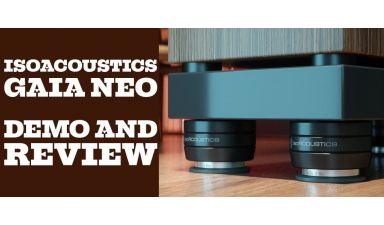
- IsoAcoustics GAIA Neo Isolation Feet: precision isolation feet enhancing clarity, focus, and stereo imaging.
- Atacama Moseco 7 Speaker Stands: rigid bamboo and steel stands offering stability and tonal neutrality.
- IsoAcoustics Aperta Sub XL: subwoofer isolator tightening bass and reducing room boom.
Recommended categories: Speaker stands, speaker isolation accessories
For a real-world test of speaker isolation feet on floor-standing speakers, our IsoAcoustics GAIA Neo review covers a direct side-by-side comparison with audible results across a range of music.
Room Interaction and Acoustic Treatment
Speakers interact with the room as much as with electronics. Reflections, standing waves, and furniture placement can shape what you hear more than you might expect. While major room treatments are specialist territory, a few small changes make a big difference.
Tips for better room acoustics:
- Add soft furnishings or rugs to reduce reflections.
- Experiment with positioning before applying EQ or correction software.
- Use acoustic panels or diffusers in problematic areas if possible.
Notable accessories:
- Synergistic Research Black Box: low-frequency tuning device improving bass definition and control.
- Stillpoints Aperture II: hybrid acoustic panel enhancing clarity and imaging.
Cable Burn-In and Maintenance
Just like electronic components, speaker cables can benefit from a short burn-in period. During the first few hours or days of use, the dielectric materials within the cable stabilise, allowing the conductors to perform at their best. This can subtly enhance tonal smoothness and coherence.
FutureShop offers a professional free Cable Burn-In Service using the Nordost Vidar system, ensuring your new speaker cables are fully conditioned before installation. Regular maintenance, such as cleaning connector contacts with DeoxIT Gold and checking terminations for tightness, helps preserve signal integrity over time.
Speaker Optimisation Priority: Where to Start
The four areas above (cables, placement, isolation, and room) can all contribute meaningfully. The question for any listener planning improvements incrementally is which to address first. Here is the sequence FutureShop recommends, and the reasoning behind it, adapted to the two most common starting points.
For standmount speakers on stands (the most common starting point):
- Placement first, free. Before any purchase, spend time with speaker positioning. Even a well-placed system sounds better than a perfectly-cabled one in a poor position. Start with equal distances from the front wall, establish an equilateral triangle with the listening seat, and experiment with toe-in in small increments. Moving the listening chair slightly can often resolve bass unevenness without any acoustic treatment.
- Speaker cable upgrade. Once placement is optimised and the baseline is reliable, a speaker cable upgrade is the most immediately audible improvement in a standmount system. Standmount speakers are typically more revealing than floorstanders at the same price, and the cable's timing and tonal character is more exposed. For guidance on which brand to choose, the Atlas vs QED vs Chord Company guide gives the brand-level comparison, and our most reviewed products list shows which cables customers chose and rated most highly in 2025.
- Jumper cable upgrade (if bi-wire terminals are present). If your speakers have separate bass and treble terminals connected by factory-supplied metal links, replacing those links with quality jumper cables is the highest-leverage small improvement available. Factory links are typically low-grade stamped metal. A quality jumper such as the Chord Epic X or Tellurium Q equivalent costs less than most cables and improves the quality of the signal path at the speaker terminal itself.
- Isolation feet or platform under the stands. For standmounts on hard floors, isolation at the stand-to-floor interface improves bass definition and tightens the stereo image. On carpet, mass-loading the stands with Atabites sand or equivalent is typically the more productive step. The isolation approach by floor type is covered in more detail in Part 6: Vibration and Support.
For floorstanding speakers:
- Placement first, free. Floorstanders are more susceptible to room boundary effects than standmounts because their bass output is closer to floor and wall surfaces. The single most productive free change for floorstanders is pulling them further into the room: even 20-30cm additional distance from the rear wall significantly improves bass clarity in most rooms.
- Speaker cable upgrade. The same principle applies as for standmounts, but the cable's current-carrying capacity becomes slightly more important for floorstanders that present a lower or more variable impedance load. The Atlas Hyper or QED Silver Anniversary XT are well-suited starting points for most floorstander pairings at mid-range system values.
- Isolation feet. For floorstanders, isolation feet (such as the IsoAcoustics GAIA Neo on hard floors) are typically more productive earlier in the upgrade sequence than for standmounts, because the cabinet's direct floor contact creates a significant vibration feedback path that affects midrange clarity. The GAIA Neo review linked above gives a clear sense of the audible benefit in practice.
- Room acoustics. Floorstanders tend to excite room modes more energetically than standmounts. If bass sounds boomy or uneven after placement and isolation have been addressed, the acoustic treatment guidance in Part 7: The Listening Room covers the correct treatment approach for bass mode problems.
The Takeaway
Your speakers give voice to everything in your system. By improving cable quality, termination, isolation, and placement, you can unleash their true potential, revealing more depth, texture, and presence in your music. Every small adjustment brings you closer to the performance your system is capable of delivering.
If you are working through the full series, the previous instalment covers your amplifier: Part 2: The Amplifier. Next up is power and grounding: Part 4: Power and Grounding. The complete series overview is in the series summary and index.
Browse our full range of speaker cables, jumper cables, speaker stands, and speaker isolation feet at FutureShop, backed by our 60-day money-back guarantee on cables. We also offer a free cable burn-in service on all speaker cables. Not sure where to start? Get in touch with our team. With over 15 years advising customers on speaker optimisation, we are happy to help.