This guide was written by Phillip Powell, who has over 15 years of experience advising customers on hi-fi system building and optimisation at FutureShop. This is Part 6 of the Upgrading Your Hi-Fi System series.
Our Verdict
Mechanical vibration is one of the most overlooked performance barriers in hi-fi. A quality rack, isolation feet, and properly positioned speakers create the physical conditions for your components to operate without interference, recovering focus, timing, and tonal purity that vibration quietly takes away.
Quick Take
- Transformers, motors, and speakers generate mechanical vibrations that travel through furniture and floors, subtly smearing detail and adding harshness across your whole system
- A purpose-built hi-fi rack resists vibration, manages cable routing, and allows proper ventilation. The material choice (bamboo, aluminium, steel) also influences tonal character
- Isolation feet and platforms decouple components from surfaces, preventing vibration from travelling between devices and improving clarity and control
- For speakers, stability is critical. Use isolation feet on hard floors and spikes on carpets. Even small wobbles blur transients and reduce imaging accuracy
- Speaker positioning matters as much as isolation: experiment with distance from walls and toe-in angle to balance bass and soundstage width
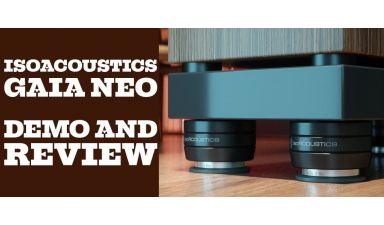
- Floor-standing speaker isolation, as tested in our IsoAcoustics GAIA Neo review, can make a clearly audible difference to bass control and overall clarity
Controlling the Physical Environment
Every sound you hear begins as a vibration, so it's no surprise that unwanted vibrations can colour or distort your music. The physical stability of your system has a direct effect on timing, detail, and tonal balance. Proper vibration control allows your components to operate in optimal conditions, letting the system sound cleaner, tighter, and more natural.
Why Isolation Matters
Audio components are sensitive instruments. Transformers, motors, and even speakers themselves can introduce mechanical vibrations that travel through furniture and floors. These resonances affect how circuits and moving parts behave, subtly smearing detail and adding harshness. By isolating components and speakers from these mechanical disturbances, you can recover focus, soundstage depth, and tonal purity.
Hi-Fi Racks: The Foundation of Performance
A purpose-built hi-fi rack provides a stable platform that resists vibration while allowing proper ventilation and cable management. Materials like bamboo, aluminium, and steel offer different resonance characteristics that can influence tonal perception.
Notable products to explore:
- Atacama Evoque Eco 60-40 SE2: rigid support platform improving component stability.
- Atacama Storm 6 Vinyl Storage Rack: heavy isolation platform enhancing turntable performance.
- Bassocontinuo Essenza Proton Rack: premium equipment rack combining rigidity and low resonance.
Recommended categories: Hi-Fi Racks
For a detailed look at how rack design affects performance, our Quadraspire Hi-Fi Rack Review covers the Q4, SVT, and X-Reference in depth.
Isolation Feet and Platforms
Isolation feet and platforms act as mechanical filters, decoupling equipment from the surface it sits on. This helps prevent vibration from travelling between components, improving clarity and control.
Notable products to explore:
- IsoAcoustics zaZen: isolation platform improving focus and micro-detail.
- Connected Fidelity Float 30: adjustable isolation feet offering improved clarity and control.
- HiFiSTAY Soft Jelly: mechanical grounding system that channels vibration away from sensitive electronics.
- AudioQuest Sorbothane Sheet: damping sheet reducing vibration transfer under components.
Recommended categories: All Isolation Products, System Isolation, Rack Isolation
Speaker Positioning and Stability
Your speakers physically move air, so stability is essential. Even small wobbles can blur transients and reduce imaging accuracy. Proper spikes or isolation platforms couple speakers firmly to the floor or isolate them from resonant surfaces.
Tips for setup:
- Use isolation feet on hard floors and spikes on carpets for best stability.
- Adjust speaker stands or feet for perfect levelling and consistent imaging.
- Experiment with distance from rear and side walls to balance bass and soundstage width.
Notable products to explore:
- IsoAcoustics Aperta Stands: standmount speaker isolator improving imaging and openness.
- Atacama Apollo Cyclone Speaker Stands: heavy-duty speaker stands offering stability and controlled resonance.
- Atacama Atabites Inert Filler: high-density stand-filling material improving damping and mass.
- HiFiSTAY Stella Double Swing Isolation Foot: high-precision isolation feet combining stability and finesse.
Recommended categories: Speaker Stands, Speaker Isolation
To see speaker isolation tested in practice on floor-standing speakers, our IsoAcoustics GAIA Neo review covers a direct side-by-side comparison on Focal Aria Evo X speakers.
Which Isolation Approach Suits Your System and Floor?
The categories above tell you what isolation products do. The more practical question is which approach suits your specific component type and floor situation. The right solution differs significantly between a suspended timber floor, a solid concrete floor, and a carpeted room, and between a turntable, a DAC, and a pair of floorstanding speakers.
Turntables on suspended timber floors: This is the most demanding combination in hi-fi isolation. A suspended floor flexes under footfall, and that low-frequency energy travels directly through the rack into the turntable platter bearing and tonearm. The correct solution is two-stage isolation: the rack itself should sit on a high-mass or heavily damped design, and the turntable should sit on a purpose-built isolation platform above that. Products like the IsoAcoustics zaZen or a TCI Podium placed under the turntable address the problem at the component level. For the most challenging suspended floors, a wall-mounted shelf fitted to a load-bearing wall is the most effective solution: it bypasses the floor entirely.
Electronics (DAC, amplifier, streamer) on any floor type: For electronics, the isolation goal is different from turntables. Electronics do not have moving parts that respond to footfall directly, but they are affected by airborne vibration from the speakers and by the resonance of the rack shelf they sit on. Low-profile isolation feet such as the HiFiSTAY Soft Jelly or a Sorbothane-based solution placed under each component address this effectively. The DAC is the highest priority (clock circuit sensitivity), followed by the amplifier, then the streamer. Floor type makes relatively little difference for electronics: the primary isolation path is vertical through the shelf, not through the floor.
Standmount speakers on speaker stands, hard floors: On hard floors, spikes on speaker stands couple the stand rigidly to the floor, which increases stability but transmits vibration bidirectionally: speaker energy travels into the floor, and floor vibration travels into the speaker. On hard wooden or stone floors, isolation feet between the stand and the floor decouple this path. The HiFiSTAY Stella Double Swing and similar high-precision isolation feet are designed for exactly this application. The IsoAcoustics Aperta placed between the speaker cabinet and the stand top-plate addresses vibration at the cabinet interface.
Standmount speakers on speaker stands, carpeted floors: On carpet, spikes are the conventional solution: they penetrate the carpet pile and couple the stand to the subfloor beneath, increasing stability and reducing lateral wobble. Carpet itself provides a degree of decoupling between the stand and the floor. The combination of spikes to the subfloor and Atacama Atabites mass-loading inside the stands produces the most stable and inert speaker platform in a carpeted room.
Floorstanding speakers: Floorstanding speakers combine the cabinet vibration problem with the floor coupling problem simultaneously, as the cabinet and the floor are in direct contact. On carpet, spikes remain the conventional approach. On hard floors, dedicated isolation feet such as the HiFiSTAY Stella Double Swing or the IsoAcoustics GAIA range fit under the speaker's existing spike threads and decouple the cabinet from the floor without reducing stability. The GAIA Neo review linked above gives a clear account of what this change delivers in practice on hard and carpeted floors.
Rack material and tonal character: The article mentions bamboo, aluminium, and steel as rack materials. Each has a different resonance signature. Bamboo (used in Atacama designs) has natural damping properties and a slightly warm character; it suits systems where brightness or hardness is a concern. Aluminium racks have a more neutral to slightly detailed character and suit systems that are already musically rounded. Steel racks tend toward neutral rigidity and suit systems where outright stability is the priority over tonal character. This is not a difference of large magnitude, but in well-developed systems it is audible and worth considering alongside the component choices the rack will house.
The Takeaway
Mechanical vibration is one of the most overlooked performance barriers in hi-fi. By improving the physical foundation of your system, from racks and platforms to speaker stability, you create the ideal environment for your electronics to perform without interference. The result is music that feels more open, precise, and effortlessly engaging.
If you are working through the full series, the previous instalment covers connectivity and cabling: Part 5: Connectivity and Cabling. Next up is the listening room: Part 7: The Listening Room: Acoustics and Environment. The complete series overview is in the series summary and index.
FutureShop stocks a full range of hi-fi racks, speaker stands, isolation products, and speaker isolation feet. Not sure which products are right for your system and floor type? Get in touch with our team. With over 15 years advising customers on system building and vibration control, we are happy to help.