FutureShop stocks the full Node Audio SS1 ecosystem, including core modules, cable riser attachments, and speaker spike adaptors. This review is based on a dedicated demonstration at Node Audio's Cambridge manufacturing facility, using SPL Diamond DAC, SPL Elector preamplifier, SPL Power amplifiers, and Node Hylixa speakers, with a follow-up session on our own reference system.
Our Verdict
The Node Audio SS1 is the most effective isolation device we have tested under digital source components, with cumulative gains across streamers, DACs, and preamplifiers that are audible and, crucially, reversible: removing the SS1s collapses the improvement immediately. The cable risers and speaker isolation configurations extend these gains further, making the SS1 ecosystem a genuinely system-wide upgrade.
Quick Take
- The SS1 combines three isolation mechanisms in one unit: a ferrous stainless steel base for focusing stray magnetic fields, ceramic bearings for draining micro-vibrations, and a multi-layer ceramic stack for mechanical vibration absorption. No other isolation product we have used addresses all three simultaneously.
- Place SS1s strategically, not symmetrically: position them below the power transformer, output circuits, and digital circuits of each component rather than simply spacing them evenly. A fourth unit can be added for stability.
- The biggest gains came from digital source components: the Aurender A10 streamer and SPL Diamond DAC both produced immediately audible improvements in spaciousness, separation, and low-level detail.
- Power amplifiers showed a more subtle improvement than source components, consistent across both the Node Audio facility and our own system: richness and better focus, but less dramatic than the digital end of the chain.
- The cable risers are genuinely effective. Removing them after the listening session caused vocals to smear back together, confirming the effect is real rather than expectation bias.
- SS1s are manufactured in England, sold individually at £272 each, and are designed as a scalable system: start with three under your streamer or DAC and expand from there.
The Game-Changing Isolation Pucks for Hi-Fi Purists
Now and again, we get approached by merchants heralding hot and new audio-enhancing objects. Some of them get our curiosity, Node Audio got our attention.
Tony's pitch of the SS1's more than raised an eyebrow – these isolation pucks, he claimed, do not simply decouple your equipment; they drain vibrations and whip stray magnetic fields into line. Okay, we don't have anything that does that on our shelves; let's hear what they can do. When could you come in and show us, Tony?
The SS1 Ecosystem: More Than Just Isolation Pucks
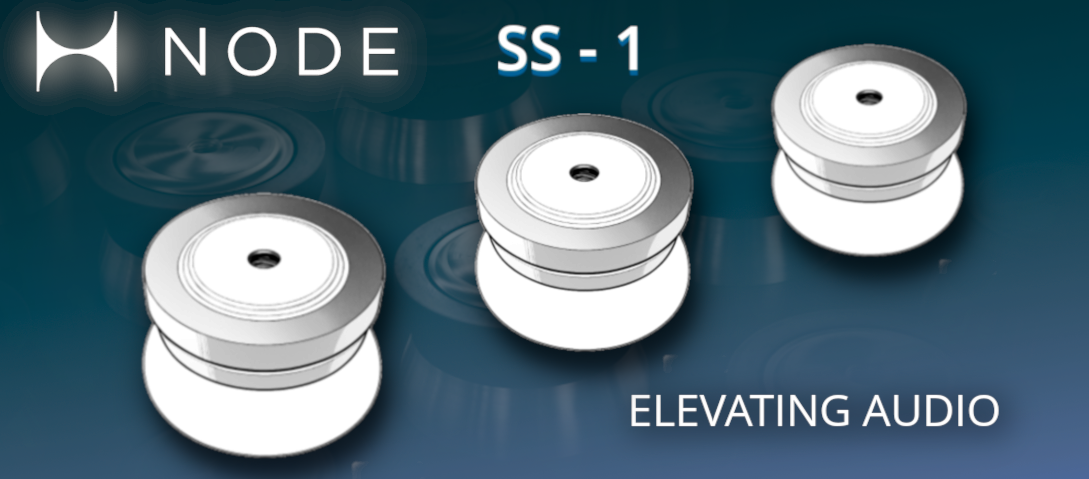
They are not just pucks, either. Node Audio also make a collection of, let's call them, hats, that screw on as cable risers or speaker supports. The SS1s are an ecosystem of hi-fi isolation products used throughout your hi-fi setup.
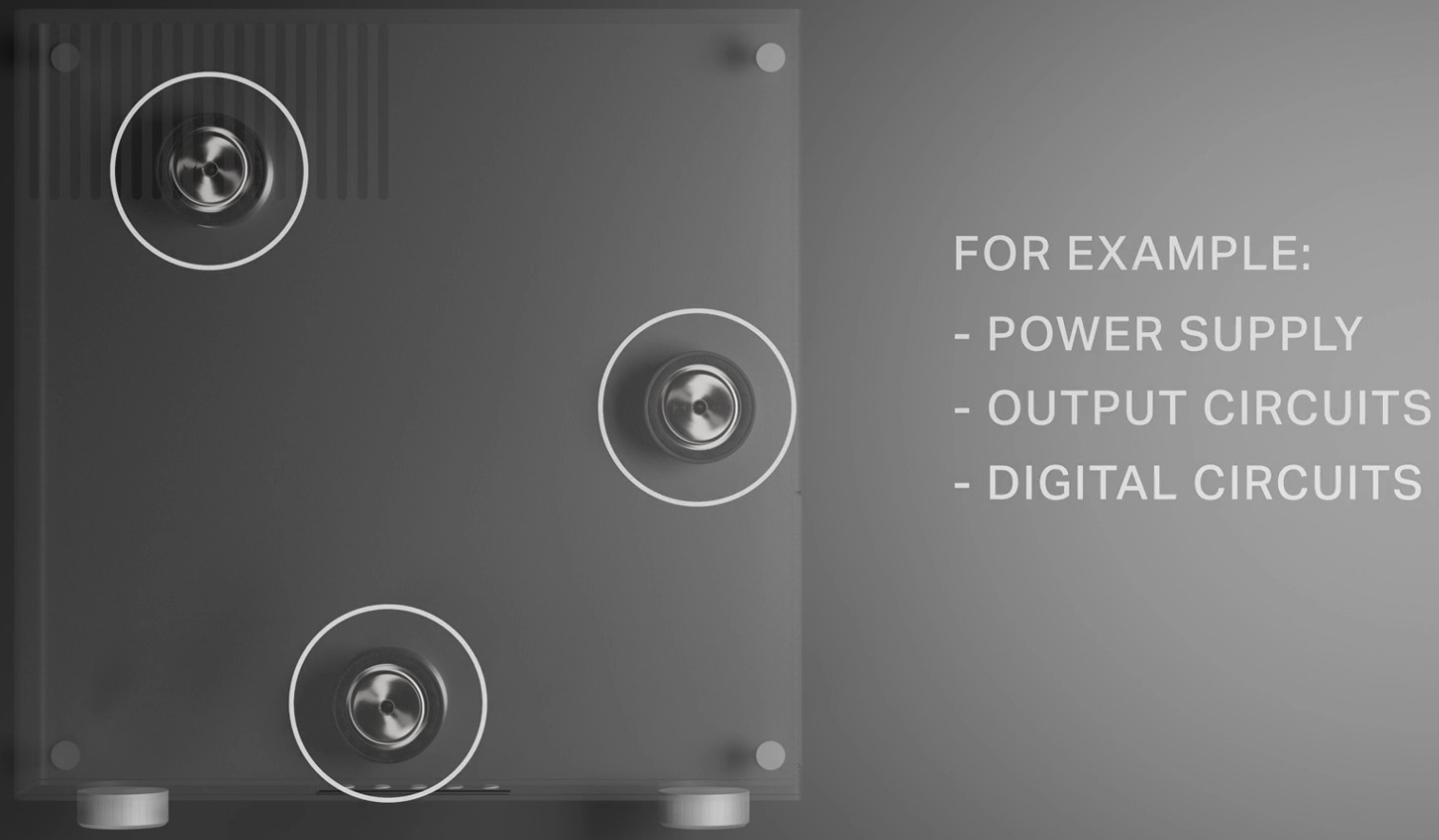
On their own, SS1s can be strategically placed under a component in sets of 3 or 4. Strategically placed? Their most intriguing feature is their effect on components' magnetic fields. The image demonstrates an effective arrangement of three SS1s beneath an amplifier – below the power supply, output circuits and digital circuits. Where are they located? The power transformer is easily found (it's after the power cable comes in), the output circuits will be on the opposite side mid-way and the digital circuits might be at the front. A fourth SS1 can be placed for stability if needed.
Built for Sonic Perfection: How SS1s Work
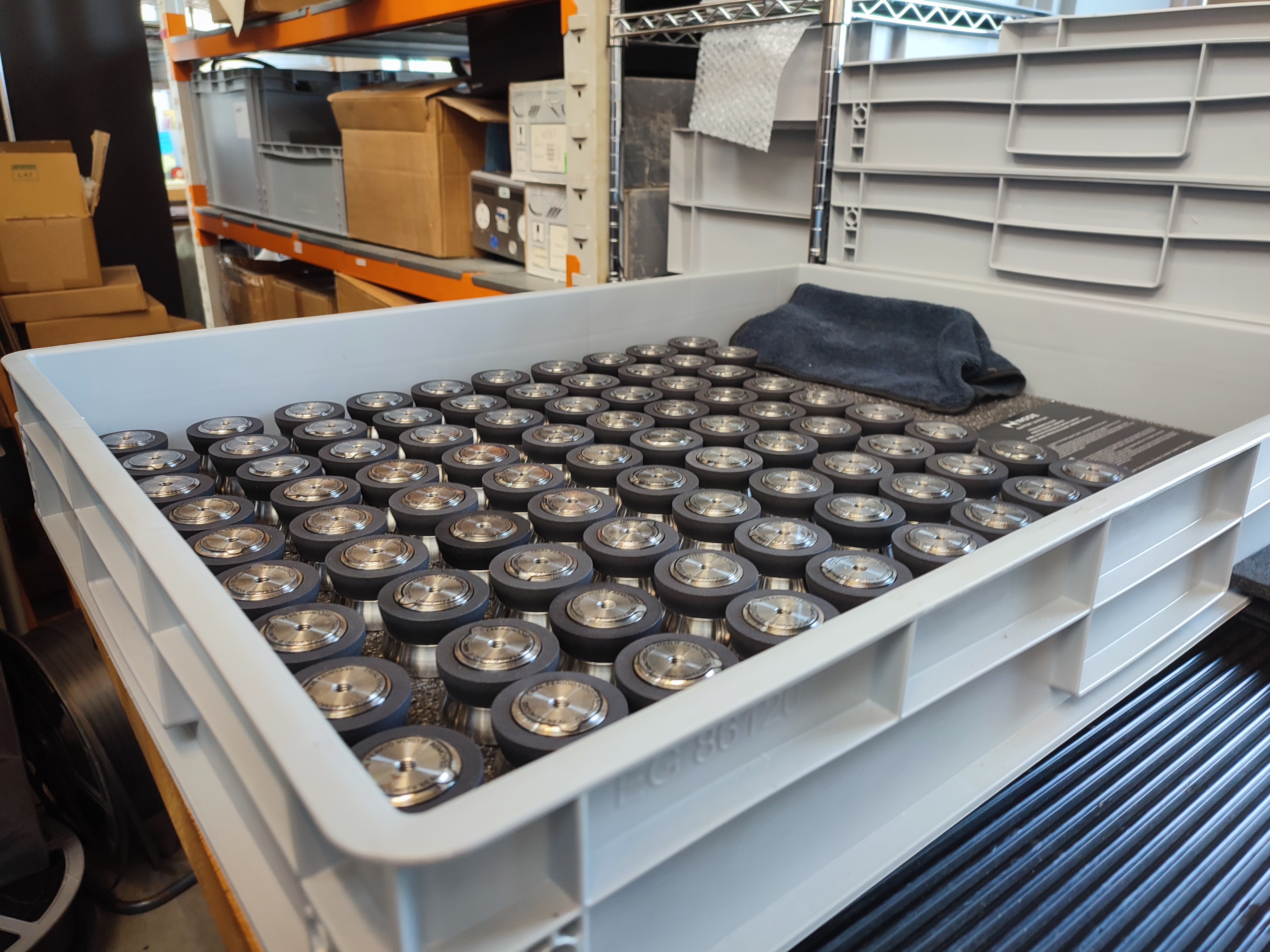
The construction is also intriguing – the top is laser printed from a glass/nylon material while the base is machined stainless steel (a ferrous material for focusing stray magnetic fields). The very top is a gimbal arrangement that adjusts itself for uneven loading and sits on ceramic bearings that drain micro-vibrations. At its core, is a 'ceramic stack' – layers of different materials that drain mechanical vibration. The 'hats' are support attachments that adapt the SS1s to other tasks. The tall one, resembling Sauron the Dark Lord, suspends different gauge speaker cables off the floor. Cable lifters – do they even work? I guess we'll find out. The short one shaped like a bat's head holds chunkier power cords. The effect of these is likely to be more mechanical than electromagnetic. They also do carpet spikes to place underneath the SS1, with screw-on spike shoes on top.
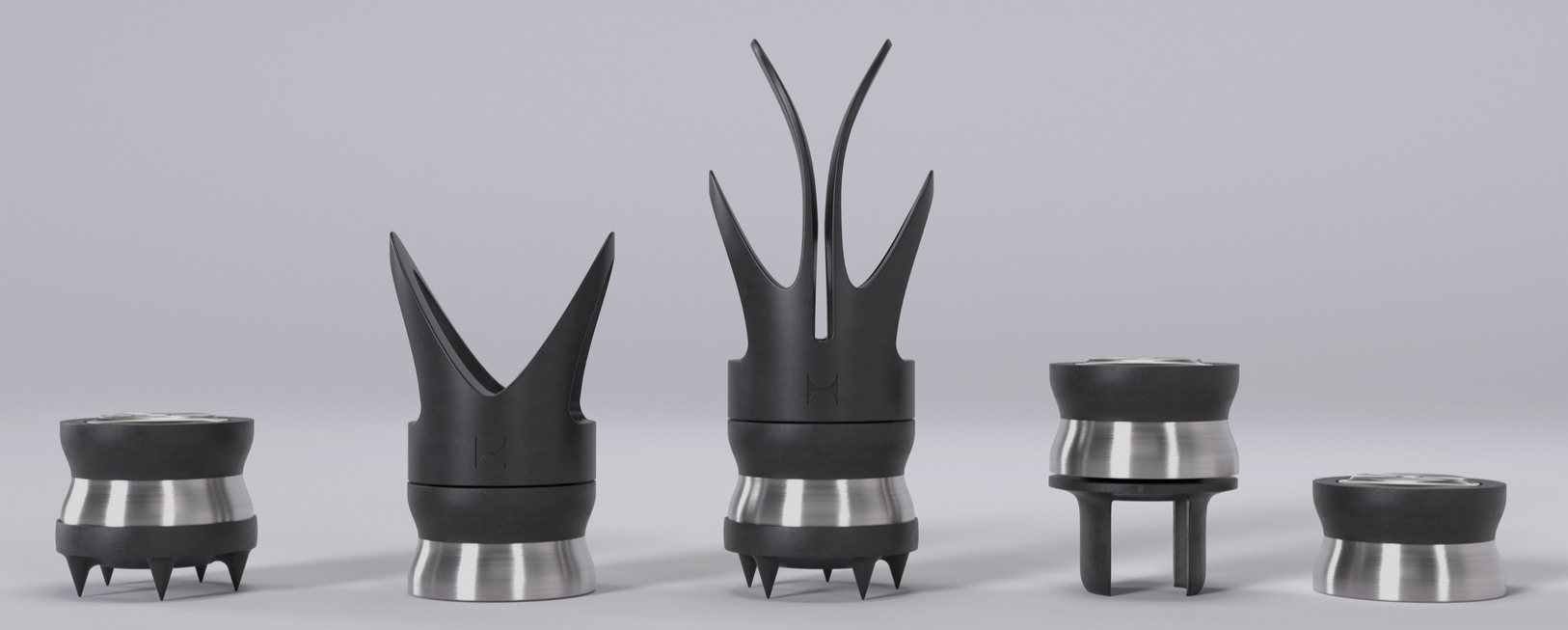
| SS1 configuration | Primary function | Price |
|---|---|---|
| SS-1 Core Module | Component isolation: streamers, DACs, preamps, power amps. Use in sets of 3 or 4, placed below magnetic field sources | £272 each |
| SS-1 Speaker Cable Riser | Lifts speaker cables clear of the floor to reduce microphony. Use in sets of 3 per side along cable run | £391 |
| SS-1 Power Cable Riser | Lifts heavier power cords clear of the floor. Improved transient timing noted in our testing on the Chord M6 power block feed | £365 |
| SS-1 Speaker Spike Adaptor | Places SS1s directly under speakers for vibration absorption and mechanical decoupling from the floor | £290 |
| SS-1 Adaptors (accessories) | Individual attachment accessories including carpet spikes and spike shoes for use with the core module | From £18 |
A/B Testing: The SS1s vs. Bare Components
We had three shots at testing these curious items: Tony and product designer Ashley brought a caseload to us, left some samples for us to hear at our leisure, and recently invited us to Cambridge to visit the manufacturing plant (SS1s are made in England). SS1s were planted beneath one component at a time and continued being planted like a bed of expensive steel tulips (we counted 32 by the end of the session) until most of the system was levitated 3cm higher.
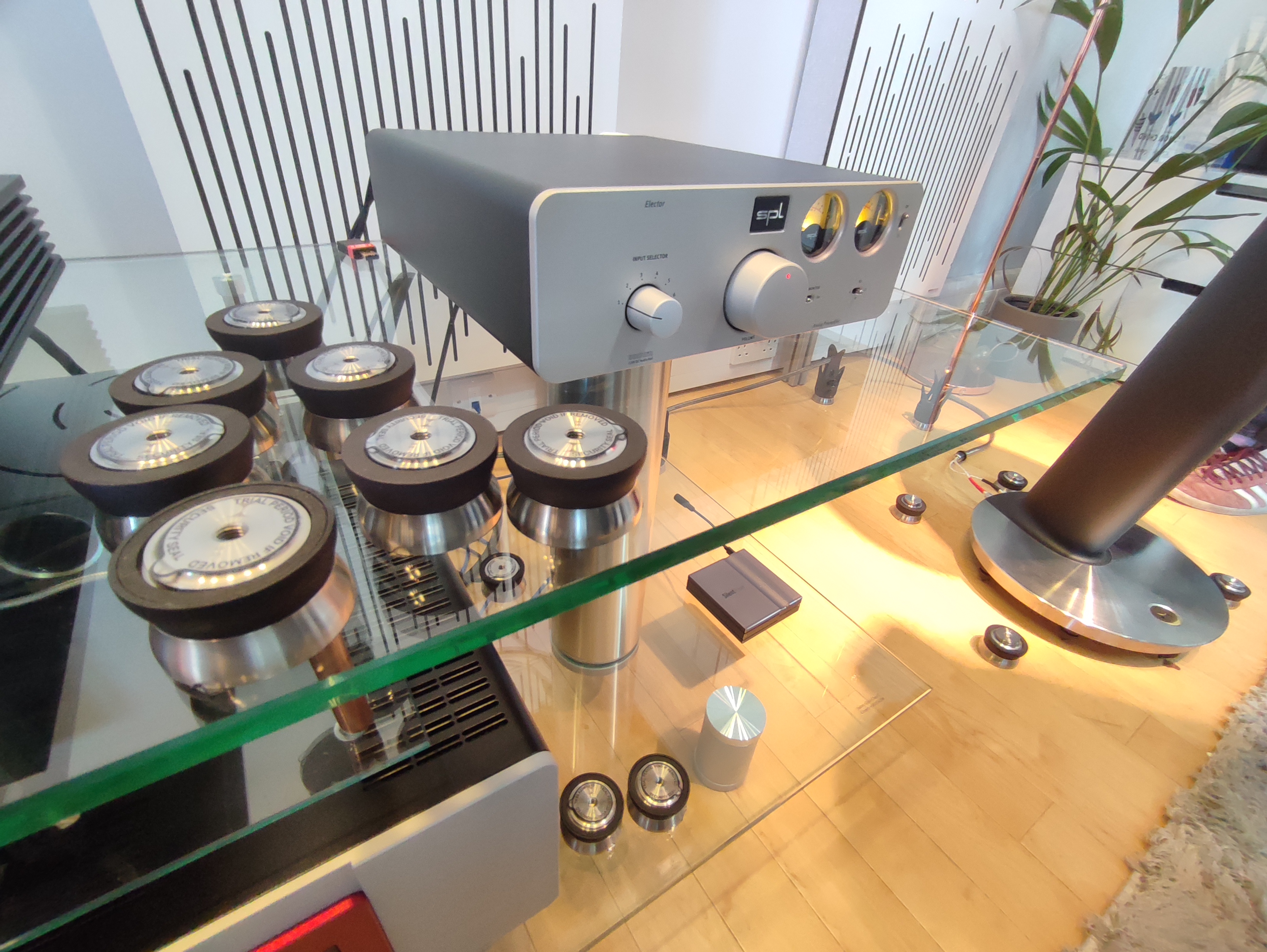
After listening with no SS1s, the first component to get the treatment was the streaming device – an Aurender A10. Three SS1s were cunningly arranged beneath it for optimum performance and the first of two test tracks issued from Node's own Hylixa speakers: Cara Dillon, There Were Rose – her beautifully interpreted, affectingly true folk tale of conflict's tragedy and pointless loss during Northern Island's troubles.
We all heard the same improvement: the music became spacious and clear. The flat sound which audio enhancements try to dispel began dissolving. In the second track, Club for Five's neoteric cover of Brothers in Arms, Tuukka Haapaniemi's basso profundo voice resonated above the haunting sopranos – a promising start. Ashley, sensing our verve, planted another three under the SPL Diamond DAC (source components being the first-place electronic fuzz permeates). Cara's sweet song got sweeter and fuller; the studio reverb had more space to decay while Club for Five's basso profundo went even more profundo. Node Audio's sonic seasoning continued beneath the SPL Elector Preamplifier. The soundscape of Brother in Arms was separated into an immersive 3D space. The same happened to the delicate recording of There Were Roses – the harmonies separated from the lead and the studio room gained breathing space and dynamics.
Next, both Ashley and Tony hoisted up the matching SPL Power amplifiers and sharply slid more SS1s beneath them before their arms gave out. Interestingly, the improvement was less drastic than on the earlier components in the chain (we noticed this back on our system, too). There was richness and better focusing but the six units under the power amplifiers were a subtle refinement.
Cable Risers Rising High
We stroked our chins in apprehension while the cable risers were arranged three-a-side on the last leg of the music's journey – the cables to the two Hylixa speakers, staring at us like giant snails' eyes.
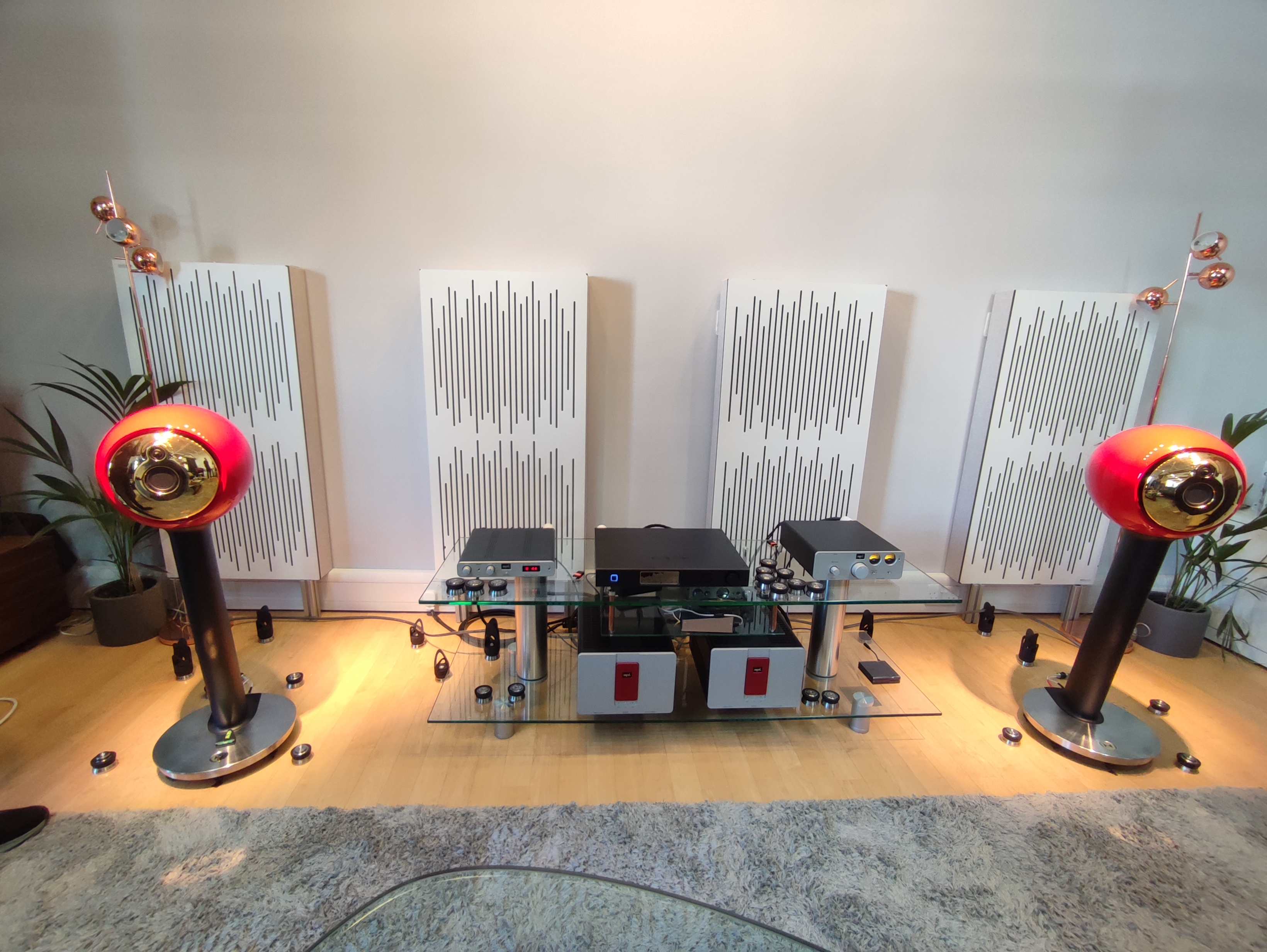
The risers held the cables clear of the floor and any possible microphony; we wondered if any microphonic vibrations were left after two dozen isolation feet were doing their thing below the rest of the system. Honestly, the cable risers were curiously effective. The Club for Five track opened wider, letting those shimmering sopranos float into the room. Cara's lead vocal took a step closer, away from the harmonies. Just to confirm, we took the risers away – the vocals smeared back together.
Three more SS1 risers were placed under the power cord to the Chord M6 Power Block. Transients were prominent and timing improved.
Speaker Isolation: Literally Raising the Bar
No stone (or component) was left unturned, Tony and Ashley wanted us to completely understand what SS1s can do and put another four of the things under each speaker (have you lost count, yet?).
Both tracks were surprisingly rounded but with deeper dynamics. To alleviate the repetition, we dropped a different track – something heavier: Stay With Me by John Summit – with and without the speaker feet in situ. The vocals in this soaring drum 'n bass track floated above the rolling beats. The arpeggio line was dynamic, and the droning bass was well-defined and lush (it was refreshing hearing some bass and upping the pace).
The Moment of Truth: Removing the SS1s
They even put one under the network switch for good measure, but you get the picture by now.
To reassure us the effects of the SS1s were not placebo, we played one of the songs before they were all swept away. The clean, solid, dynamic sound that had propagated over the last hour or so suddenly flattened. In comparison, we got the thorns on Cara's roses. The sounds lost definition and punch, smearing together. Don't get us wrong, when we began, the sound was good but, as always, it is when it's gone you miss it.
Verdict: Are SS1 Isolation Pucks Worth It?
Our visit to Node Audio's facility satisfied us that the SS1 ecosystem had justified its existence. We can isolate our audio gear in many ways, but Node Audio's alchemic objects offer something extra. We found the SS1 the most effective device we have tried for digital components like streamers and DACs. We even tried some on a humble Wiim Ultra streamer (we know – that triples its price!) but found them incredibly effective. Hearing cable risers on both their system and ours, was another ear opener. On the right system – right, meaning where everything else is addressed – they are a finishing touch.
But do you need 32 of these things? Well, if you still have money left in the bank to take your partner on the holiday of a lifetime, by all means, order another set. What was learned, today, was Node Audio's SS1 offers a unique and effective treatment useable in all areas of your music system.
If you are interested in how the SS1 compares to platform-style isolation at a similar price point, our TCI Podium review covers that approach in detail. And if speaker isolation specifically is your priority, the IsoAcoustics GAIA Neo review is a useful comparison for feet that work on a different mechanical principle.
The full Node Audio SS1 range is available now at FutureShop, including the Core Module, Speaker Cable Riser, Power Cable Riser, and Speaker Spike Adaptor. Not sure where to start in the ecosystem? Get in touch with our team for free expert advice.