This guide was written by Phillip Powell, who has over 15 years of experience advising customers on hi-fi system connections and cable selection at FutureShop. We stock a full range of RCA interconnects and XLR balanced cables from leading hi-fi brands.
Our Verdict
There is no universal winner. If your equipment is fully balanced internally, XLR is the stronger choice. If your system is single-ended or uses short cable runs, a well-designed RCA cable is often the more direct and logical solution. Always match the connection to the circuit design, not the socket on the rear panel.
Quick Take
- RCA is unbalanced and has been the domestic hi-fi standard for decades. For short cable runs and single-ended equipment, it performs exceptionally well
- XLR is balanced and offers common-mode noise rejection. Most beneficial for long cable runs, separate pre and power amplifiers, and fully balanced circuit designs
- If your component has XLR sockets but is single-ended internally, XLR may offer no sonic advantage and can add an extra conversion stage
- RCA-to-XLR adaptors do not create true balanced performance. If your equipment is single-ended, use RCA
- For turntables and phono stages, high-quality low-capacitance RCA is the correct approach in most systems
- Construction quality, cable geometry, and correct length often matter more than the choice of connector format
If you're upgrading your hi-fi system, one of the most common questions is: should I use RCA or XLR connections? Some believe balanced XLR is automatically superior. Others insist RCA sounds more natural. The truth is more nuanced and depends entirely on your equipment design, room environment, and cable length.
What Is an RCA Connection?
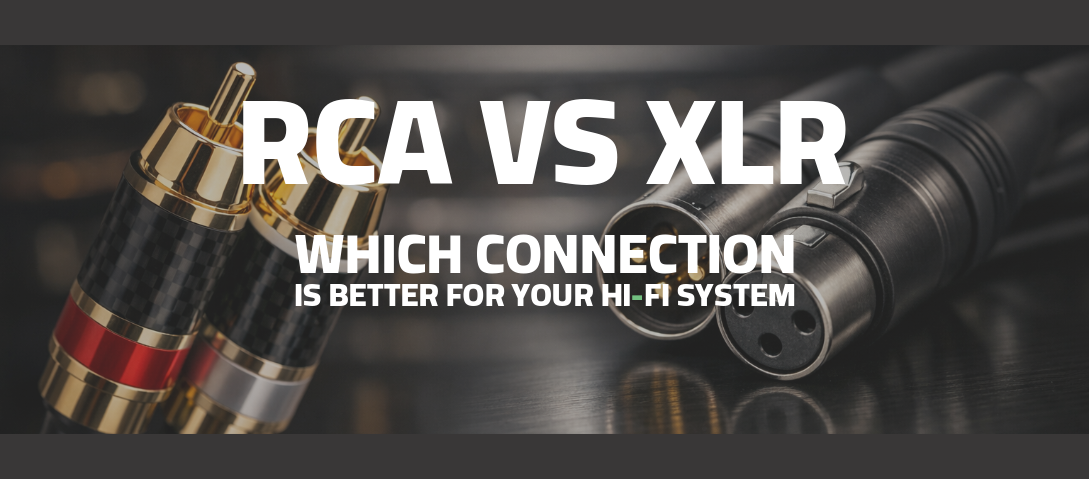
RCA is an unbalanced analogue connection. It uses one signal conductor and one ground/shield.
RCA has been the standard in domestic hi-fi systems for decades. Most DACs, CD players, phono stages, integrated amplifiers and streamers include RCA outputs and inputs as standard.
Because it carries signal and ground together, RCA is slightly more susceptible to interference than balanced designs. However, in typical home systems with short cable runs, this is rarely an issue.
What Is an XLR Connection?
XLR is a balanced connection, originally developed for professional studio environments. It uses three conductors: positive signal, negative signal, and ground.
The key advantage is common-mode noise rejection. Any interference picked up along the cable is cancelled out when the signal is recombined at the receiving end.
This makes XLR ideal for long cable runs, environments with electrical interference, and fully balanced amplifier designs.
Does XLR Sound Better Than RCA?
This is where most confusion comes in.
If Your Equipment Is Fully Balanced
If both your source and amplifier are designed as true balanced circuits internally, XLR can lower the noise floor, improve channel separation, and deliver greater dynamic range. In these systems, balanced connections are often the optimal choice.
If Your Equipment Is Not Fully Balanced
Many hi-fi components include XLR sockets for convenience, but internally convert the signal to single-ended circuitry.
In this case, XLR may offer no sonic advantage, RCA can sometimes sound more direct, and you may simply be adding an extra conversion stage. This is why connection choice should always match the circuit design, not just the socket on the rear panel.
Which Hi-Fi Brands Are Actually Balanced?
The most practically useful question is not "does XLR sound better in principle?" but "is my specific amplifier or source actually balanced internally?" The answer varies significantly by brand and even by model within a brand.
Genuinely balanced throughout: Balanced circuit design from input to output is the norm in professional audio and in some high-end hi-fi brands that have adopted the same architecture. Hegel, Balanced Audio Technology (BAT), Aesthetix, Bryston, and Pass Labs build genuinely balanced differential circuits throughout their amplifier stages, meaning XLR connections exploit the full benefit of the design. Chord Electronics' Hugo TT 2 and DAVE are designed with balanced output stages. Burmester produces fully balanced designs across most of their range. If you own equipment from these brands, XLR is generally the correct connection for optimal performance.
Single-ended internally despite XLR sockets: This is far more common than most buyers realise. Naim Audio is the most discussed example: Naim amplifiers use a DIN-based circuit philosophy and their XLR sockets are present for convenience, but the circuitry is single-ended. Using XLR on a Naim amplifier adds a conversion stage that Naim themselves do not endorse. Similarly, many integrated amplifiers from Cambridge Audio, Arcam, and Marantz at the mid-range include XLR sockets that are wired to single-ended circuitry internally. For these amplifiers, RCA is the correct connection and often sounds more direct.
Balanced in some models, single-ended in others: Many manufacturers offer both within the same product line, and the distinction is not always clear from the marketing. Musical Fidelity produces genuinely balanced designs in their M8 series but single-ended designs in lower ranges. Luxman and Accuphase produce fully balanced designs in their higher-priced models but single-ended designs at entry and mid-range. Rega amplifiers are single-ended throughout. Linn's DSM streamers include XLR outputs that are balanced, while Linn's Klimax and Akurate amplifiers use a proprietary connection standard. For any amplifier where you are unsure, the manufacturer's documentation or a direct question to the manufacturer will tell you definitively whether the circuit is balanced or single-ended.
How to check without documentation: The simplest indicator is output voltage. A truly balanced output typically produces double the output voltage of the single-ended output on the same component (6V balanced versus 3V single-ended, for example). If the balanced and unbalanced outputs on your component produce the same voltage, the XLR socket is almost certainly a single-ended signal re-terminated in a balanced connector rather than a true differential balanced output.
When RCA Is Absolutely Fine
For most domestic systems with cable runs under 2-3 metres, low electrical interference, and integrated amplifiers, RCA performs exceptionally well.
In fact, many high-end manufacturers still voice their equipment primarily around single-ended operation. For shorter interconnects between DAC and amplifier or phono stage and integrated amplifier, a well-designed RCA cable is often the most logical solution.
When XLR Makes Sense
Balanced interconnects are especially beneficial if you're running cables longer than 3 metres, you have separate pre and power amplifiers, your equipment is fully balanced internally, or you have a complex AV rack environment with multiple interference sources.
In these cases, noise rejection becomes meaningful. Browse our range of XLR balanced cables if your system fits this profile.
What About Turntables?
Turntables are extremely sensitive to capacitance and grounding. Most phono stages and turntables use RCA as standard. Balanced phono setups do exist, but they require a balanced phono stage, compatible cartridge wiring, and correct grounding.
For most vinyl systems, high-quality low-capacitance RCA remains the correct approach.
Should You Convert RCA to XLR?
Using adaptors rarely creates true balanced performance. An RCA-to-XLR adaptor does not make a signal balanced. It simply re-terminates the connection. If your equipment is single-ended internally, stick with RCA.
System Matching Matters More Than Connector Type
In real-world systems, the biggest improvements do not usually come from the balanced versus unbalanced debate. They come from proper system matching, cable geometry, shielding quality, connector integrity, and correct cable length.
Whether you choose RCA or XLR, construction quality often has a greater impact than connector format alone.
Final Verdict: RCA vs XLR
There is no universal winner.
Choose RCA if: your system is single-ended, cable runs are short, or you want simplicity.
Choose XLR if: your equipment is fully balanced, cable runs are long, or noise rejection is important.
If you're unsure, check your manufacturer's circuit design or speak to a specialist before deciding. Matching the connection type to the equipment design will always yield better results than assuming one format is superior.
If you're also thinking about how cable brand and construction affects sound, our guide to Atlas vs QED vs Chord Company covers system matching in detail for speaker cables, with the same principles applying to interconnects.
Browse our full range of RCA interconnects and XLR balanced cables at FutureShop, with free UK delivery and a 60-day money-back guarantee on cables. Not sure which connection is right for your system? Get in touch with our team. With over 15 years advising customers on system connections, we are happy to help.