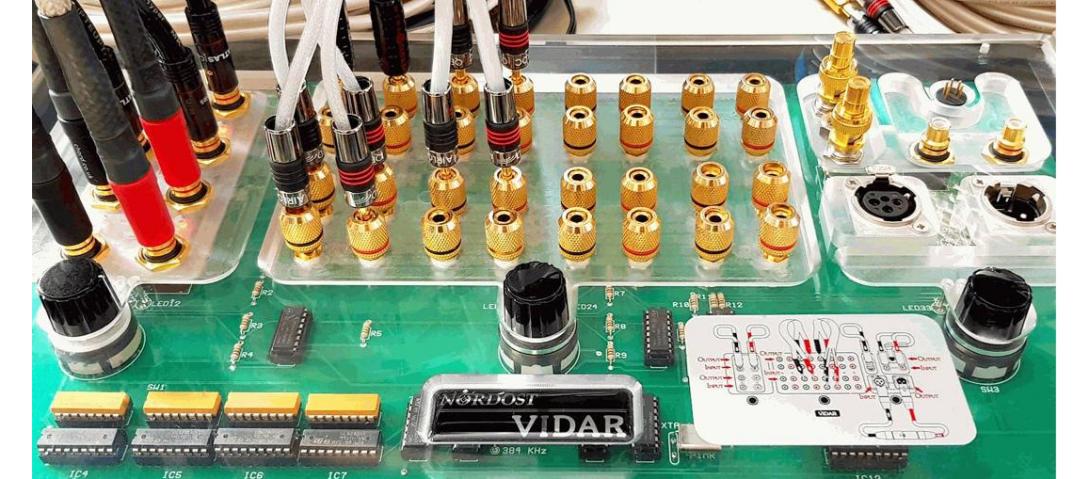
FutureShop offers a free cable burn-in service on selected cables purchased from us, using a Nordost Vidar Cable Conditioning Machine. This article explains what burn-in does, how the Vidar achieves it, and which cables qualify.
FutureShop's Free Burn-In Service
When you purchase selected cables from FutureShop, we burn them in on our Nordost Vidar machine before dispatch at no extra charge. New cables typically sound brittle and bright out of the box due to electrical charges trapped during manufacture. The Vidar conditioning process accelerates what would otherwise take 100 to 200 hours of system use, so your cables arrive ready to perform rather than requiring weeks of break-in time in your system. Learn more about the service.
Quick Take
- New cables often sound brittle, bright, and lacking in detail due to high electrical charges and trapped gases from the production process. These resolve with use, but the process can take weeks or months naturally.
- The Nordost Vidar accelerates this by combining three processes in one operation: charge neutralisation, deep conductor core conditioning, and ultrasonic surface conditioning of the conductors.
- The Vidar uses 44 bridge-mode amplifiers at precisely matched voltages and sends complex signals at both ultra-low and ultra-high frequencies simultaneously. The beat frequencies between these signals penetrate all layers of the cable.
- Cables eligible for FutureShop's free burn-in: speaker cables, analogue interconnects (RCA/XLR), tonearm cables (5-pin DIN to RCA/XLR), digital interconnects (RCA/XLR/BNC), USB, Ethernet, and power cables.
- Cables not eligible: headphone cables, non-standard XLR pin-outs, RCA-to-XLR interconnects, and video/computer cables (HDMI, DVI, component video).
- Burn-in time varies by cable type. As a general guide, analogue interconnects typically benefit from 24 to 72 hours on the Vidar; power cables and speaker cables typically require longer.
Burning-In Your Cables: What It Is and Why It Matters
Burning-in cables is the process of conditioning them to achieve their maximum performance. The phenomenon is well-established: cables sound better after a period of use in a system. This improvement occurs due to physical and electrical changes in both the conductor and the insulation material as charges are dissipated and the cable settles into its final electrical characteristics.
New cables often arrive with very high levels of electrical charge caused by the production process. Gases are frequently trapped between the insulation and the conductor during manufacture. Together, these factors can cause new cables to sound brittle, bright, and lacking in detail. These charges must be neutralised for the cable to reach its potential, and in a passive system this happens gradually over weeks or months of normal use.
The Nordost Vidar Cable Conditioning Machine accelerates this process significantly. FutureShop is one of relatively few specialist dealers in the UK to own a Vidar and offer its use as a free service on cables purchased from us.
How the Nordost Vidar Works
The Nordost Vidar uniquely combines three different conditioning functions in a single operation:
- It neutralises the charges that build up around the cable and its insulation during manufacture.
- It provides a wideband and deep conditioning signal into the conductor core, producing changes in the way signals are transmitted through the metal.
- It ultrasonically conditions the surface of the conductors.
The Vidar is constructed using the highest quality components. Each conductor path is fed by a bridge-mode amplifier. The machine uses 44 amplifiers in total, each held at a precisely controlled voltage. The circuit is designed so that the voltage difference between any two amplifiers is zero, ensuring perfectly balanced conditioning throughout the cable.
The Vidar applies a proprietary combination of composite and complex signals to condition the cables. Parts of the signal operate at ultra-low frequencies, while other parts operate at ultra-high frequencies that extend beyond the range of video signals. This signal bounces in a ping-pong ball-like fashion from one end of the cable to the other.
During the conditioning process, the ultra-low frequencies penetrate deep into the core of the cable, while the ultra-high frequencies work along the conductor surface. This simultaneous action creates beat harmonics between the two complex waveforms (in digital terms, these would be referred to as aliasing products). These beat frequencies penetrate all layers of the cable, conditioning the entire structure simultaneously.
The Vidar's circuitry also drives electrons from the conductor core upward into the dielectric (insulation) area. This not only conditions the conductor surface but also neutralises the electrical charges in the insulation that cause new cables to sound bright and edgy. The same approach is applied radially in interconnect cables, sending a conditioning signal from the centre core outward to the outer shield.
What Burn-In Achieves
The end result of conditioning cables with the Nordost Vidar is consistent and audible. Customers who receive pre-conditioned cables from FutureShop typically report improved sound staging, increased retrieval of fine detail, and a more musical, natural presentation compared to the same cables used straight from the box without conditioning.
The improvement is not subtle on cables that have had no prior use. A new analogue interconnect or speaker cable that has been conditioned on the Vidar will behave as if it has been run in a system for several weeks, without the listener having to wait for that period to pass.
Which Cables Qualify for FutureShop's Free Burn-In Service?
FutureShop's free burn-in service is available on selected cables purchased from us. The following cable types are ideal for treatment on the Nordost Vidar:
- Speaker cables
- Analogue interconnects with RCA or XLR termination
- Tonearm cables that use a 5-pin DIN connector to RCA or XLR termination
- Digital interconnects with RCA, XLR, or BNC termination
- USB and Ethernet cables
- Power cables
The following cables cannot be treated on the Vidar and are therefore not eligible for the service:
- XLR interconnects with non-standard pin-outs
- Headphone cables (any cable with a 6.3mm or 3.5mm headphone jack at one end)
- Interconnects with mixed terminations such as RCA to XLR
- Video or computer cables: component video, HDMI, DVI
How Long Does Burn-In Take, and What Should You Expect?
The time required for effective conditioning varies by cable type and construction. The table below gives indicative Vidar conditioning times for common cable categories and describes what the improvement typically sounds like.
| Cable type | Typical Vidar time | Equivalent passive burn-in | What the improvement sounds like |
|---|---|---|---|
| Analogue interconnects | 24 to 72 hours | 50 to 200 hours of system use | Brightness and edge reduce. Soundstage opens. Midrange becomes more natural and less clinical. Fine detail previously masked by high-frequency edge becomes audible. |
| Speaker cables | 72 to 120 hours | 100 to 300 hours of system use | Bass tightens and becomes more controlled. Imaging sharpens. The character described by the manufacturer in their product documentation becomes more apparent. |
| Power cables | 72 to 120 hours | 100 to 200 hours of system use | Background noise floor drops. The system gains a greater sense of ease and authority. Improvements are often more apparent on source components than amplifiers during initial use. |
| Digital interconnects and USB | 24 to 48 hours | 50 to 150 hours of system use | Jitter-related edge and glare reduce. Timing feels more coherent. Streaming and computer audio sources in particular benefit, as the cable often connects equipment with significant local interference. |
| Ethernet cables | 24 to 48 hours | 50 to 100 hours of system use | Improvement is subtler than with analogue cables but consistent: streaming playback gains stability and a quieter background, particularly noticeable on high-resolution and DSD streams. |
A note on burn-in after the Vidar: Even after Vidar conditioning, cables will continue to improve with system use. The Vidar accelerates the initial period significantly, but most cables continue to settle over their first few weeks in a system. Expect further marginal improvement over 50 to 100 hours of system use after receiving a conditioned cable.
For the companion maintenance step after burn-in, our connector cleaning guide covers how to maintain the quality of the contact points themselves using Caig DeoxIT. And for a deeper understanding of why power cables benefit from burn-in and what changes in the conductor during the process, our power cables guide (Vol. 2i) covers dielectric and conductor behaviour in full.
FutureShop's free burn-in service is available on selected cables purchased from us, at no extra charge. All cables also carry our 60-day money-back guarantee. Get in touch with our team to confirm whether a specific cable is eligible for burn-in before ordering.