FutureShop stocks contact cleaning products from Caig Laboratories and other specialist brands. Both DeoxIT products below are available from stock.
Why Connector Cleaning Matters
Metal connectors oxidise over time. The oxidation layer forms a barrier between the mating surfaces, increasing resistance and degrading signal quality. Cleaning connectors removes this layer and restores the quality of the electrical contact. For most systems, this takes under 30 minutes, costs under £30, and produces an improvement that often rivals a cable upgrade. It should be part of every system's regular maintenance.
Quick Take
- DeoxIT (Red): Step One: Dissolves oxidation and corrosion. Use this first on any connector showing discolouration, intermittent behaviour, or reduced clarity. 20% active cleaner in 100% liquid suspension. Safe around most materials.
- DeoxIT Gold: Step Two: Use after the Red to enhance conductivity and protect the cleaned surface. Molecularly bonds to both base-metals and plated surfaces, sealing out oxygen. Reduces wear, arcing, and RFI. Ideal for gold-plated connectors.
- Both products should be used in sequence, not interchangeably. Red cleans; Gold protects and enhances. Using Gold on an oxidised surface without the Red first is less effective.
- A 2ml tube of each is sufficient for multiple cleaning sessions on a typical two-channel system. Very little product is needed per connector. Excess should always be wiped off.
- Clean every connector in the system: RCA, XLR, banana plugs, spades, speaker terminals, and phono cartridge pins. The improvement is cumulative across the system, not just audible on one connection.
- Repeat every three to six months. In humid environments or older systems, more frequent cleaning is worthwhile.
Cleaning Your Connections: Why It Matters and How to Do It
Connector cleaning is one of the most overlooked maintenance tasks in hi-fi, and one of the most rewarding. Over time, the metal surfaces of every connector in your system (RCA plugs, banana plugs, XLR pins, speaker terminals) develop a layer of oxidation. This layer increases resistance at the contact point and degrades the quality of signal passing through it. The effect is gradual and easy to miss until the cleaning is done and the comparison is made. FutureShop stocks two products from Caig Laboratories that address this in two complementary steps.
Caig DeoxIT Contact Cleaning Fluid
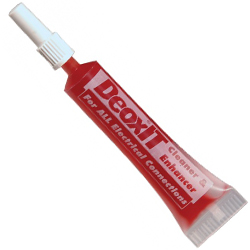
DeoxIT dissolves oxidation and corrosion on metal surfaces, filling in the microscopic gaps between contact surfaces to form a better electrical connection. It is 100% liquid and contains 20% active chemical cleaner, making it safe to use around most materials. Use this as the first step on any connector that has been in service, shows visual discolouration, or is producing intermittent behaviour or reduced clarity.
Directions for use
- Turn off and unplug the device.
- Apply a small amount to the metal contact or connector surface.
- Operate the connector (plug and unplug several times) to help break up oxides and contamination. Wait a few minutes, then wipe the surface with a clean lint-free cloth or cotton swab to remove loosened oxidation.
- Re-apply a small amount to the metal surface and wipe off the excess. DeoxIT works best when a thin coating remains on the surface. Wait two minutes before turning on the equipment. Test for compatibility before use on unusual materials.
- For severe oxidation: apply, leave overnight, then remove contaminants with a lint-free swab on all accessible surfaces. When the swab comes away clean, finish with a small final application and wipe off the excess, leaving only a thin layer.
- If green or black discolouration appears on the surface after application (this may take a few days), this indicates dissolved oxidation from a severely oxidised surface. Repeat steps 2 to 5 once more.
Caig DeoxIT Gold Contact Cleaning Fluid
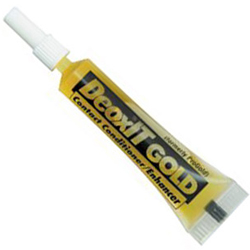
DeoxIT Gold is the second step, used after the Red on surfaces that have already been cleaned. Where DeoxIT Red removes oxidation, DeoxIT Gold enhances conductivity and protects the cleaned surface from future oxidation. It molecularly bonds to both base-metals and plated surfaces, sealing out oxygen and maintaining contact quality between cleaning sessions. The Gold coating also reduces wear abrasion, arcing, and RFI, and is particularly effective on gold-plated connectors, which are common on higher-end cables and equipment.
On surfaces showing active oxidation, always pre-treat with DeoxIT Red before applying Gold. Using Gold on an oxidised surface without the Red first is less effective, as Gold is a protectant and enhancer rather than a primary cleaner.
Directions for use
- Turn off and unplug the device.
- On surfaces that have been in service or show visual signs of oxidation, pre-treat with DeoxIT Red first.
- Apply a small amount of DeoxIT Gold to the metal contact or connector surface.
- Operate the connector to distribute the Gold and break up any minor residual oxides. Test for compatibility before use on unusual materials.
- Re-apply DeoxIT Gold and wipe off the excess. DeoxIT Gold works best when a thin coating remains on the surface. Wait two minutes before turning on the equipment.
- If green or black discolouration appears after application (may take a few days), this indicates dissolved oxidation from a severely oxidised surface. Repeat steps 2 to 5 once more.
Which Connectors Benefit Most?
Every metal connector in your system benefits from cleaning, but some connection points respond more noticeably than others. The table below maps connector type to the specific oxidation challenge and the correct cleaning sequence.
| Connector type | Common problem | Cleaning sequence | Priority |
|---|---|---|---|
| RCA phono | Oxidation on the plug body and pin. Often shows as a subtle loss of high-frequency clarity and image focus over time. | Red first, Gold second. Clean both the plug and the socket. | High. RCA connections are typically in service for years without cleaning. |
| Banana plugs and speaker terminals | Oxidation reduces the contact area between plug and terminal. Often shows as reduced bass weight or dynamic compression. | Red first on both the plug and the terminal socket. Gold second on both. Cotton buds are useful for terminal sockets. | High. Speaker terminals are rarely cleaned and accumulate oxidation quickly. |
| XLR balanced | Pin oxidation and housing contact degradation. XLRs are robust but benefit from cleaning if the connection is intermittent or the cable is rarely removed. | Red on the pins. Gold after. Be sparing on the housing contact. | Medium. XLRs typically oxidise more slowly than RCA due to better contact pressure. |
| Phono cartridge pins | Extremely fine pins that oxidise readily. Degraded contact produces a thin, bright, or dynamically compressed vinyl playback character. | DeoxIT Gold only, applied with a fine cotton bud or cocktail stick. The pins are delicate: do not apply pressure. Red is too active for this application. | High for turntable users. One of the most audible improvements in an analogue system. |
| IEC power cable sockets | Power connections oxidise in the same way as signal connections. Cleaning the IEC socket and power cable pins removes noise introduced at the power supply entry point. | Red first, Gold second. Always ensure the component is unplugged from the wall before cleaning. | Medium. Particularly worthwhile on components with upgrade power cables. |
By using these two products on all your cable connectors once every three to six months, you will maintain the quality of every electrical connection in your system and prevent the gradual degradation that oxidation causes. The improvement after a full system clean is typically immediate and audible.
For further reading on how connector and plug quality affects signal quality at the design level, our speaker cables guide (Vol. 3) covers plug materials, plating, and termination methods in full. And for other accessories that improve system performance without cable changes, our must-have accessories guide covers isolation, USB noise filtering, and grounding products.
Caig DeoxIT and DeoxIT Gold are available now at FutureShop. Browse the full contact cleaner range, including ChordOhmic and Clean-IT, or get in touch with our team for free expert advice on which product suits your connectors.