Atlas Cables
Built to order in Kilmarnock, so a 2.7 metre run with one end changed is routine rather than a special request. Pure copper throughout, which tends to settle a bright system rather than sharpen it
About Atlas Cables
Quick Access
What Atlas do differently, and why it matters that they build it themselves
Most cable brands design in one country and manufacture in another. Atlas do both in Kilmarnock, and that single fact explains a lot about how they operate. Custom lengths are ordinary rather than special orders. Termination changes are a production decision rather than a negotiation with a supplier. If a cable needs to be 2.7 metres with one end changed, that is a normal Tuesday.
Two engineering positions run through the range. The first is OCC copper, drawn as a continuous cast so the conductor has far fewer grain boundaries than standard copper. Fewer boundaries means fewer points where the signal meets a discontinuity.
The second follows from the first. OCC does not take kindly to post-processing at high temperature, so soldering was ruled out from the start. Atlas cold-weld the connector instead, joining it under pressure so the two metals bond directly, with no third metal of different conductivity sitting in the signal path. That decision also meant designing and making their own plugs, since nothing off the shelf was built for it.
Neither position is unique to Atlas, but doing both, in-house, at prices that start well below high-end territory is unusual. It is why the entry ranges hold up better than their price suggests.
Shop by Range
Atlas run one ladder for their signal cables, from Element at the entry point up to the Asimi silver range. The biggest single step is Hyper to Mavros, where OCC copper runs throughout. Eos and Zeno sit outside the ladder and cover mains and headphone cables. Most Atlas cables can be built to a custom length.
-
 SALEFrom£175.00 £207.50Inc. VAT ✓ Save £32.50
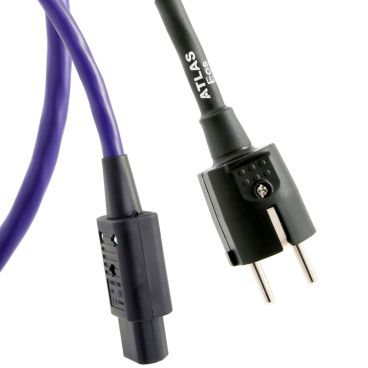
The Eos 1.5em Power Cable uses OFC conductors in a sophisticated fully screened configuration, implementing Atlas' ‘dd’ (dual drain) screening in an entry-level power cable for the first time.