This guide was written by Stevyn Durham at FutureShop. We stock a full range of RCA, XLR, DIN, phono, and mini-jack cables from leading brands including Chord Company, QED, AudioQuest, and Atlas, all backed by our 60-day money-back guarantee.
Our Verdict
The right analogue cable depends entirely on what you are connecting: RCA for unbalanced hi-fi connections, XLR where balanced circuitry is available, phono cables for turntables, and DIN for Naim and Linn systems. Using the wrong type costs you signal quality; using the right type with quality construction reveals what your system is genuinely capable of.
Quick Take
- Analogue cables carry the actual audio waveform as voltage, not binary data. This makes them more sensitive to material quality, shielding, and interference than digital cables
- RCA (phono plug) is the standard for unbalanced hi-fi connections. Keep runs under 5 metres and use shielded cables near power cables or other electronics
- XLR balanced cables cancel out noise using common-mode rejection. They can run 30 metres or more with virtually no signal loss and are the right choice wherever equipment supports balanced circuitry
- Phono/turntable cables are a distinct category: the signal from a cartridge is 2 to 5mV (far below line level), requires RIAA equalisation, and needs high shielding and low capacitance. A standard RCA cable used as a phono cable will result in thin, distorted sound
- DIN cables are the correct choice for Naim and Linn systems and minimise ground loops by combining signal paths in a single plug
- Construction quality matters across all cable types: conductor material, insulation capacitance, shielding effectiveness, and connector plating all affect clarity, imaging, and long-term reliability. For a deeper comparison of leading brands, see our RCA vs XLR guide
Well done. You live in a digital world and still want to know what's what with analogue cables. You are a person who's got very specific taste – just our type.
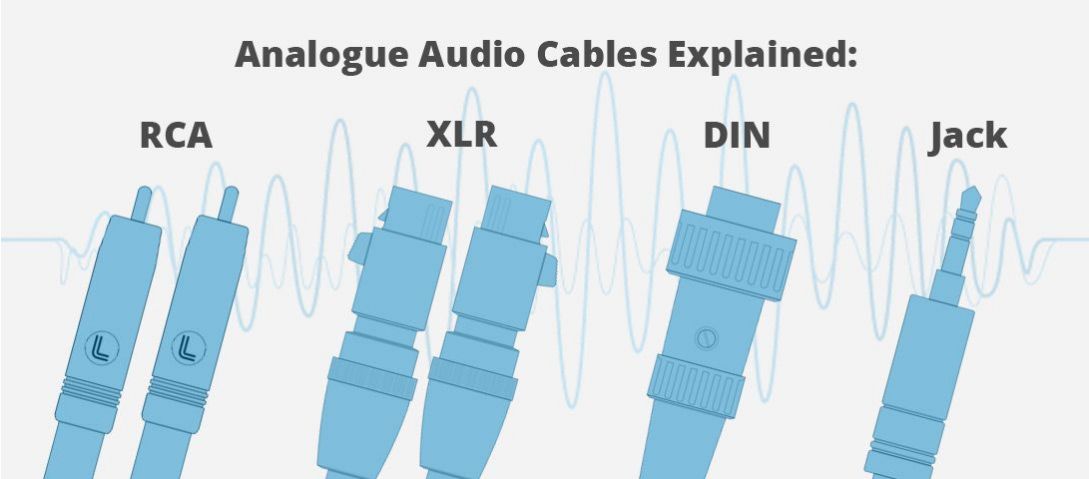
When it comes to connecting your audio system, analogue audio cables play a crucial role in how your music or sound is delivered. While digital audio appears to dominate, analogue still rules the world of vinyl records, hi-fi systems, home studios, and live audio setups. Knowing the ins and outs (literally) of cable types like RCA, XLR, DIN, phono, 3.5mm and 6.35mm jacks can steer you towards your setup's best possible sound.
In this comprehensive guide, we'll cover the most common analogue audio connectors, explain how they differ in usage and performance, and help you decide which is right for your gear.
What Are Analogue Audio Cables?
Analogue audio cables transmit electrical signals that directly represent sound waves. Unlike digital cables that carry binary code, analogue cables carry the actual waveform as voltage. Because of this, signal integrity, interference, shielding, and impedance all affect sound quality.
The most common types of analogue audio connectors include:
- RCA
- XLR
- DIN
- 3.5mm (mini jack)
- 6.35mm (¼ inch jack)
- Phono cables (used with turntables)
Each serves a different purpose based on application, equipment type, signal level, and distance. What are the pros and cons of each type?
RCA Cables: The Home Audio Staple
RCA cables (sometimes called phono plugs) are a long-time favourite in consumer electronics. Named after the Radio Corporation of America, RCA connectors became standard in the 1940s and remain common today.
RCA Cable Overview
- Typical Use: Connecting amplifiers, CD/DVD players, DACs (with amplifiers), streamers, tuners, tape decks, gaming consoles, and turntables (with preamps).
- Signal Type: Unbalanced analogue signal.
- Connector Design: Usually colour-coded: red for right channel and white (or black) for left channel.
- Number of Conductors: 2 (signal and ground). Uses coax cable (typically).
Performance Insights
RCA cables are best for short-distance transmission, usually under 5 meters. Since they're unbalanced, they're prone to electromagnetic interference and signal degradation over longer distances.
Tip: For better performance, choose shielded RCA cables, especially if they run near power cables or other electronic devices.
Browse our full range of RCA interconnects, including Chord Company, Atlas, QED, and AudioQuest.
XLR Cables: The Balanced Audio Champion
XLR cables are the professional standard in live sound, broadcasting, and recording studios.
XLR Cable Overview
- Typical Use: Microphones, audio interfaces, mixers, PA systems, and studio monitors.
- Signal Type: Balanced analogue signal.
- Connector Design: 3 pins: positive (hot), negative (cold), and ground.
- Construction: Rugged design with locking mechanisms to prevent accidental disconnection.
Why Balanced Audio Matters
Balanced cables transmit audio over two wires with opposite polarity. Any noise picked up during transmission is cancelled out at the receiving end. This is called common-mode rejection.
Performance Advantages
- Run cables up to 100 feet (30 meters) with virtually no signal loss.
- Much more resistant to hum, buzz, and interference.
- Used in setups where signal clarity and long runs are essential.
Browse our full range of XLR balanced interconnects. For a detailed comparison of when XLR outperforms RCA in a hi-fi context, see our RCA vs XLR guide.
DIN Cables: The Vintage Hi-Fi Connector
DIN connectors (Deutsches Institut für Normung) were widely used in European audio equipment in the mid-to-late 20th century.
DIN Cable Overview
- Typical Use: Vintage hi-fi systems (Naim, Bang & Olufsen), audio control interfaces, MIDI equipment.
- Connector Design: Round connector with 3 to 7 pins.
- Signal Type: Typically unbalanced, but can carry multiple signals (e.g. audio + control).
Performance Considerations
DIN connectors provide a compact, multi-channel solution but are now mostly found in retro or high-end niche gear. They're not interchangeable with RCA or XLR, and modern compatibility often requires DIN-to-RCA adapters.
Browse our DIN cable range.
Jack Connectors: 3.5mm and 6.35mm Audio Jacks
Jack connectors are versatile and found in both consumer and professional audio environments.
3.5mm (1/8") Jack
- Use Case: Headphones, laptops, smartphones, portable devices.
- Signal Type: Usually stereo unbalanced (TRS: Tip-Ring-Sleeve).
- Limitations: Small size makes it susceptible to wear, distortion, and interference over long runs.
Browse our 3.5mm mini-jack cable range.
6.35mm (¼") Jack
- Use Case: Electric guitars, studio headphones, mixing desks, audio gear.
- Signal Type: Mono or stereo; TRS for balanced mono or stereo unbalanced, TS for unbalanced mono.
- Durability: Sturdier, better-suited for professional environments.
TS vs TRS Explained
- TS (Tip-Sleeve): Unbalanced mono (e.g. guitar cables).
- TRS (Tip-Ring-Sleeve): Stereo unbalanced or balanced mono (e.g. headphone or patch cables).
Phono Cables vs RCA: What's the Real Difference?
Though phono cables often use RCA connectors, the term "phono cable" refers specifically to cables used to connect turntables to an amplifier or phono preamp.
Key Differences
| Feature | Phono Cable | RCA Cable (Line-Level) |
|---|---|---|
| Signal Level | ~2–5mV (very low) | ~0.316–2 V |
| Impedance | ~100 ohms | ~10,000 ohms |
| Noise Sensitivity | Very High | Moderate |
| Requires Preamp? | Yes (RIAA preamp) | No |
Phono signals are extremely low voltage and also require equalization (the RIAA curve) before amplification. Plugging a phono cable into a standard RCA input (line-level) will result in thin, quiet, and distorted audio.
Shielding & Capacitance
Phono cables must be highly shielded and low in capacitance, as high capacitance can dull high frequencies from your turntable cartridge.
Browse our turntable and phono cable range.
Balanced vs Unbalanced Audio Cables
Balanced cables help eliminate electrical noise and are preferred in demanding environments like live concerts, studios, and large venues.
| Feature | Balanced (XLR, TRS) | Unbalanced (RCA, TS, 3.5mm) |
|---|---|---|
| Noise Resistance | High (excellent for long runs) | Low (sensitive to interference) |
| Ideal Max Cable Length | 30+ metres | 1–5 metres |
| Use Case | Professional, Studio, Live | Home audio, short connections |
| Signal Type | Differential | Single-ended |
Does Impedance or Cable Length Affect Sound Quality?
Yes, particularly in analogue systems.
Impedance Matching:
- Phono and guitar signals are highly sensitive to impedance mismatches.
- Using the wrong cable can affect frequency response and increase noise.
Cable Length:
- Unbalanced cables (RCA, TS) should stay under 5 meters.
- Balanced cables (XLR, TRS) can go up to 100 meters without signal loss.
Capacitance:
High capacitance in cables (especially for phono or guitar) can roll off high frequencies and reduce clarity. Look for low-capacitance audio cables if fidelity is a priority.
Final Summary: Choosing the Right Analogue Audio Cable
| Connector | Best For | Signal Type | Balanced? |
|---|---|---|---|
| RCA | Home stereo, AV gear | Line-level | No |
| XLR | Microphones, Studio monitors | Mic/Line-level | Yes |
| DIN | Vintage audio equipment | Variable | No |
| 3.5mm | Phones, laptops | Stereo | No |
| 6.35mm | Instruments, headphones | Mono/Stereo | Some |
| Phono (RCA) | Turntables (needs preamp) | Low-level phono | No |
Conclusion: Make the Right Connections
Your choice of analogue audio cable can make or break your listening experience. Whether you're spinning vinyl on a classic turntable, recording in a home studio, or just hooking up a soundbar, the right cable ensures optimal signal flow, minimal noise, and clean audio.
Understanding the difference between RCA, XLR, DIN, phono, and jack cables is essential for anyone serious about sound.
FutureShop stocks the full range of RCA interconnects, XLR balanced cables, DIN cables, phono and turntable cables, subwoofer cables, and mini-jack cables from Chord Company, QED, AudioQuest, and Atlas, all backed by our 60-day money-back guarantee. We also offer a free cable burn-in service on all analogue cables. Need help choosing the right cable for your setup? Get in touch with our team.