FutureShop has been a reference dealer for Van den Hul cables since 2007. This guide draws on our hands-on experience with the full Van den Hul speaker cable range, sold and demonstrated from our Borehamwood showroom and through direct consultation with hundreds of customers over nearly two decades.
Our Verdict
Carbon and copper speaker cables are not in competition. Copper and silver prioritise conductivity and resolution, while Van den Hul's carbon-loaded cables prioritise tonal smoothness and freedom from skin-effect colouration, making them the better choice for systems that lean bright or fatiguing.
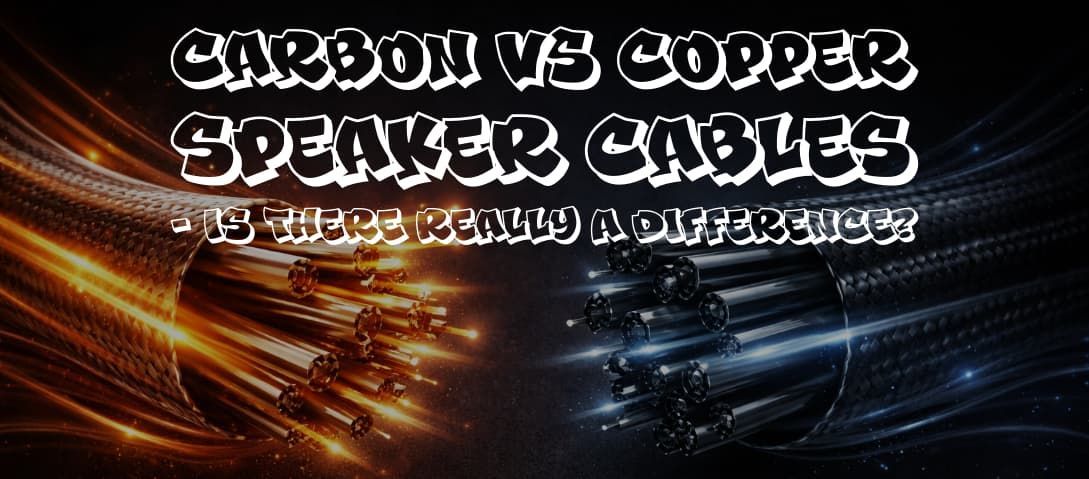
Most speaker cables are made of copper. Some use silver. Van den Hul uses carbon. It is an unusual choice, and one that prompts a fair amount of scepticism from people encountering it for the first time. Can carbon really work as well as copper in a speaker cable? And if so, why do so few other manufacturers use it? Here is a clear-headed look at both materials and what the evidence suggests.
Quick Take
- Carbon cables prioritise tonal smoothness and freedom from skin-effect colouration
- Copper typically offers greater outright resolution and attack
- Silver is the most detailed option but can sound bright in some systems
- System matching plays a major role: carbon suits systems that lean bright or fatiguing
- Hybrid carbon and metal designs, such as The Magnum, offer a practical middle ground
At a Glance: Carbon vs Copper vs Silver
| Copper (OFC/OFHC) | Silver | Carbon (Van den Hul) | |
|---|---|---|---|
| Conductivity | Excellent | Excellent (best of metals) | Lower, by design |
| Skin effect | Present | Present | Avoided by construction |
| Grain boundaries | Present (reduced in OFHC) | Present | None (polymer matrix) |
| Tonal character | Neutral to warm | Detailed, can be bright | Smooth, natural, relaxed |
| Best suited to | Most systems; wide choice of characters by brand | Systems wanting maximum resolution | Systems that lean bright or fatiguing |
| Relative cost | Moderate to high (by grade) | High | Moderate to high |
Copper: The Standard for Good Reason
Copper has been the default conductor material in audio cables for as long as audio cables have existed, and for good reasons. It is an excellent electrical conductor, second only to silver among common metals. It is also ductile, relatively affordable, and easy to work with during manufacture.
Modern speaker cables use varying grades of copper, from standard oxygen-free copper (OFC) to higher-purity variants like OFHC (oxygen-free high-conductivity) and the ultra-pure copper used by brands such as Atlas and AudioQuest. Each step up in purity is said to reduce the number of grain boundaries within the conductor, which can affect how the signal travels through it.
Copper is not perfect, however. As a metal, it exhibits the skin effect, and its grain boundaries introduce what some engineers describe as a form of subtle distortion. For most applications, these are not significant concerns. In high-end audio, where small differences are more apparent and more discussed, they have driven some manufacturers to look for alternatives.
Silver: The Premium Metal Option
Silver is a better conductor than copper and is used by a number of high-end cable manufacturers, including Van den Hul in some of their hybrid designs. Silver-conductor cables are often described as sounding more detailed and transparent than copper alternatives, though they can also sound brighter in some systems.
Silver cables command a price premium due to the cost of the material, and they are not universally preferred. The character of silver conductors suits some systems well and can sound overly analytical in others.
Carbon: Van den Hul's Alternative Approach
Van den Hul is a Dutch cable manufacturer founded by A.J. van den Hul in 1975, and is one of the few brands in the world to have developed carbon as a primary conductor material for audio cables, an approach refined over several decades of engineering research.
Carbon is not a metal, and it does not behave like one electrically. Its conductivity is much lower than copper or silver, which is why it is not used as a standalone conductor in most cable applications. Van den Hul's insight was to use carbon in a form that exploits its particular electrical properties rather than trying to compete with copper on straightforward conductivity.
In Van den Hul's carbon-loaded cables, the conductor is formed from carbon particles in a polymer matrix. The resulting material has a specific impedance profile and does not exhibit the skin effect in the same way that metal conductors do. Van den Hul argues that this means the signal travels more uniformly through the conductor across the full audio frequency range, avoiding the phase and timing inconsistencies associated with the skin effect in metal cables.
What Listeners Actually Hear
The subjective listening experience of Van den Hul carbon cables is fairly consistent across reviews and user reports. The most common descriptions are: smoother treble, a more natural tonal balance, reduced listening fatigue, and a sense that the music flows more easily. Less commonly, some listeners feel that Van den Hul cables can sound slightly soft compared to high-quality copper cables in systems that are already on the warm side.
It is worth noting that these are not universal experiences, and system matching plays a role. A system that already leans warm may not be ideally suited to Van den Hul. A system that tends towards brightness or hardness often responds very well to them.
The Hybrid Approach
Van den Hul's hybrid cables, such as The Magnum, combine carbon and metal conductors to get the best of both materials. The carbon element contributes the tonal smoothness and skin-effect avoidance, while the metal element provides the current-carrying capacity needed for more demanding loads. This is a pragmatic engineering solution that works well in practice and suits a wider range of systems than the pure carbon cables.
For those newer to the brand, The Clearwater offers a more accessible entry point. It uses silver-coated OFC conductors rather than carbon, but shares the same HULLIFLEX insulation and build philosophy, and is a well-regarded starting point for exploring Van den Hul's approach to cable design.
Which Van den Hul Cable Suits Your System?
The article above explains what carbon does. The question below it is: should your specific system have a Van den Hul cable, and if so, which one? The following guidance is based on FutureShop's experience matching Van den Hul across a wide range of customer systems since 2007.
Is Van den Hul right for your system at all? The most reliable indicator is whether your current system has a quality you would describe as bright, forward, or tiring over long sessions. Ribbon tweeters, metal dome tweeters, and some ceramic driver designs can produce a top end that benefits significantly from Van den Hul's approach. Analytical amplifiers, particularly some Class D designs and certain high-gain transistor amplifiers, can also benefit. If your system already sounds warm, rounded, and musically relaxed, Van den Hul carbon may tip the balance too far in that direction and a high-purity copper cable from Atlas or QED is likely a better fit.
Amplifiers that pair well with Van den Hul: Class A and valve amplifiers rarely need the smoothing that Van den Hul carbon provides, as their output stages are already tonally relaxed. The Van den Hul character is more valuable with solid-state transistor amplifiers, particularly those that present a clean, detailed, and slightly forward sound. Amplifiers from Musical Fidelity, Exposure, and Primare at the mid-range, and Gryphon, Pass Labs, and certain Naim designs at higher price points, are among the combinations that FutureShop customers have found to respond well to Van den Hul. That said, Van den Hul is used successfully with valve amplifiers where the speaker is the forward-sounding element rather than the amplifier.
Speakers that pair well with Van den Hul: The most consistent recommendation is for speakers with metal dome or ribbon tweeters, which can produce high-frequency energy that rewards tonal smoothing in the cable. B&W's aluminium-dome designs, Monitor Audio's ribbon designs, KEF's aluminium-dome models, and ELAC's JET folded-ribbon tweeters are among those that frequently appear in positive Van den Hul pairings. Conversely, fabric-dome tweeters in warm-sounding speakers, such as certain Harbeth, Spendor, or Sonus Faber models, are less likely to need what Van den Hul offers and may sound slightly soft or lacking in top-end openness with a pure carbon cable.
Choosing between pure carbon and the hybrid Magnum: The pure carbon cables suit systems where tonal smoothing is the primary goal, and where the speaker's impedance load is straightforward. The hybrid Magnum is the better choice when the speaker presents a challenging impedance load, such as electrostatics, difficult floorstanders that dip low in impedance, or any speaker that benefits from a cable with robust current-carrying capacity. The Magnum also suits listeners who want the Van den Hul tonal character but with more dynamic attack than the pure carbon cables provide.
Starting with The Clearwater: If you are new to Van den Hul and want to explore the brand's approach before committing to a carbon design, The Clearwater is the right starting point. Its silver-coated OFC conductors do not exhibit the full carbon character, but the HULLIFLEX insulation and Van den Hul build approach produce a cable that sounds notably different from standard copper alternatives. It sits in a price bracket that makes it a low-risk evaluation, and it is backed by FutureShop's 60-day guarantee.
So, Is Carbon Better Than Copper?
The honest answer is that it depends on what you are optimising for and what your system sounds like. Carbon is not objectively better than copper in all contexts. High-purity copper cables from Atlas, AudioQuest, or Chord Company are outstanding products that many listeners prefer. Van den Hul's carbon cables offer a different set of characteristics that suit a different set of priorities.
If you value tonal naturalness, long-term listening ease, and a smooth top end above overt detail and transparency, Van den Hul's approach is worth exploring. If your system already sounds natural and you want maximum resolution, high-purity copper or silver may serve you better.
For a broader comparison of copper-conductor brands in a similar price bracket, see our guide to Atlas vs QED vs Chord Company speaker cables.
The Bottom Line
The debate between carbon and copper speaker cables is not one with a single correct answer. It is a question of engineering philosophy and personal listening priorities. Van den Hul has spent decades refining their approach, and the results speak for themselves in the ears of their many loyal customers.
The full Van den Hul speaker cable range, including The Magnum hybrid, is available now at FutureShop with free UK delivery and our 60-day money-back guarantee on cables. Not sure which cable suits your system? Get in touch with our team. As a Van den Hul reference dealer since 2007, we're happy to help you choose.