FutureShop is an authorised dealer for Chord Electronics, a British electronics company founded in 1989 in Maidstone, Kent, known for designing all of its digital conversion technology in-house rather than using off-the-shelf DAC chips. This guide draws on direct in-store listening experience with the full Chord Electronics DAC range.
Our Verdict
Chord Electronics' FPGA-based approach to digital conversion delivers a measurably and audibly different result from traditional DAC chip implementations, with greater timing precision, a lower noise floor, and firmware upgradeability that protects the investment over time. The Mojo 2 is the most accessible entry point, the Qutest the best standalone DAC for a desktop or component system, and the Hugo TT 2 the reference-level choice for a dedicated listening system where the DAC also serves as preamplifier.
Quick Take
- Traditional DAC chips from ESS, AKM, and Burr-Brown are fixed at manufacture. Chord's FPGA implementation is reprogrammable, allowing the company to update and improve the conversion algorithms via firmware without replacing hardware.
- Chord's WTA (Watts Transient Aligned) filter uses an order of magnitude more processing taps than standard DAC chip filters, reconstructing the original waveform with greater accuracy between sample points.
- The FPGA runs Chord's proprietary noise-shaping algorithm, pushing quantisation noise to frequencies well above the audible range, producing a noise floor significantly lower than mass-market DAC chip implementations.
- The Mojo 2 is portable and battery-powered. The Qutest is a fixed DAC designed for desktop and rack integration. The Hugo 2 is portable and desktop-capable with a headphone amplifier. The Hugo TT 2 adds balanced preamplifier outputs for direct connection to a power amplifier. The DAVE is the reference flagship.
- The Chord MScaler upsampler can be paired with the Hugo TT 2 or DAVE to increase the WTA filter tap count further, extracting additional detail from any digital source.
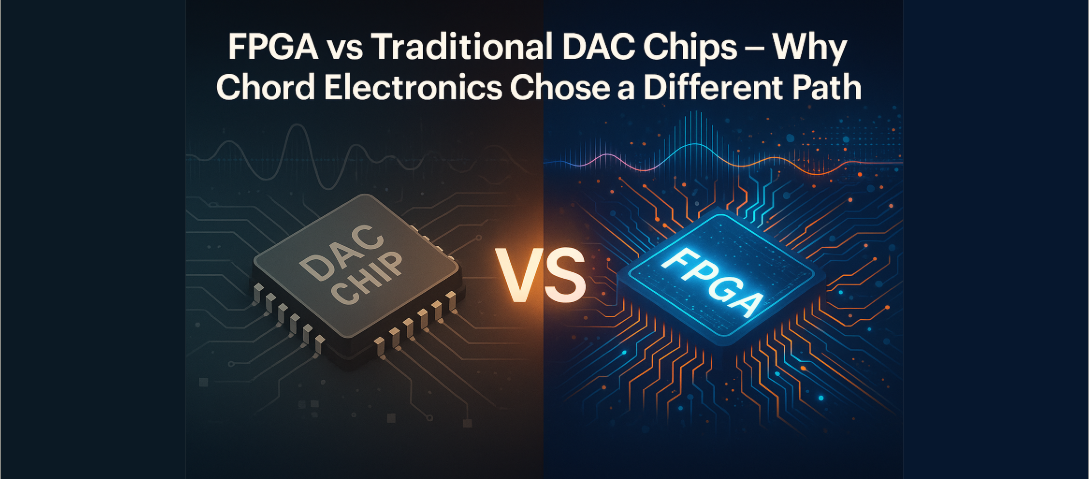
When it comes to digital-to-analogue conversion, most hi-fi manufacturers rely on off-the-shelf DAC chips from suppliers like ESS, AKM, or Burr-Brown. These chips handle the crucial job of turning your digital music into an analogue signal your amplifier and speakers can use. While convenient and cost-effective, they come with inherent limitations, both in processing capability and in how the manufacturer can fine-tune the sound.
Chord Electronics took a completely different route. Rather than using pre-made DAC chips, they design and program their own digital conversion system from the ground up, built on FPGA (Field-Programmable Gate Array) technology. This approach is at the heart of their award-winning products such as the Mojo 2, Hugo 2, Hugo TT 2, and flagship DAVE.
What is FPGA Technology?
An FPGA is a reprogrammable silicon chip that allows engineers to create custom digital processing architectures. In Chord's case, this means writing their own code for how audio is decoded, filtered, and reconstructed, unrestricted by the fixed design of mass-produced DAC chips.
FPGA vs Traditional DAC Chips: Key Differences
| Feature | FPGA DAC (Chord Electronics) | Traditional DAC Chip |
|---|---|---|
| Processing Power | Extremely high, supports advanced filtering with millions of taps | Limited by chip architecture |
| Customisation | Fully custom code for sound optimisation | Fixed by chip manufacturer |
| Noise Shaping | Proprietary algorithms for ultra-low noise | Standard noise reduction techniques |
| Upgrade Potential | Firmware updates improve performance | No performance upgrades once built |
| Timing Accuracy | Exceptional transient alignment | Dependent on chip design limitations |
| Manufacturing Control | Designed and programmed entirely in-house | Outsourced chip design |
The Benefits Over Traditional DAC Chips
- Precision Filtering: Chord's advanced WTA (Watts Transient Aligned) filters use hundreds of times more processing power than standard DACs, improving timing accuracy and musical detail.
- Custom Noise Shaping: Proprietary algorithms reduce digital noise far beyond conventional levels, resulting in cleaner, more natural sound.
- Upgradeable Performance: Because the code is written in-house, firmware updates can enhance performance over time without replacing hardware.
- Optimised for Transparency: Every design choice is made purely for sound quality, not to fit the constraints of a chip supplier.
Understanding WTA Filtering: Why Tap Count Matters
The WTA (Watts Transient Aligned) filter is the most technically significant element of Chord's FPGA implementation, and understanding it helps explain why the listening experience differs from conventional DACs.
When a digital recording is played back, the DAC must reconstruct the original analogue waveform from a sequence of discrete sample points. Standard DAC chips use a relatively short filter with a limited number of calculation steps, called taps, to perform this reconstruction. The fewer the taps, the less accurately the filter can reconstruct the original waveform between sample points, which introduces subtle timing errors that blur transients and reduce the sense of musical coherence.
Chord's WTA filter runs on the FPGA with a tap count that is orders of magnitude higher than typical DAC chip filters: the Mojo 2 uses 38,912 taps, the Hugo 2 uses 49,152 taps, and the DAVE uses 164,000 taps. These figures are not marketing abstractions; they represent the number of calculation steps the filter performs per sample to reconstruct the waveform. The audible result is more accurate transient reproduction, a cleaner background, and a greater sense of the original recording's timing and space.
The Chord MScaler takes this further by upsampling any incoming digital signal to 705.6kHz or 768kHz before passing it to a Chord DAC, increasing the effective tap count available to the DAC's WTA filter dramatically. When paired with the Hugo TT 2 or DAVE, the MScaler allows those DACs to operate at a level of waveform reconstruction accuracy that approaches the theoretical limits of current digital audio.
Proven Performance Backed by Awards
The superiority of Chord's FPGA approach is reflected in the countless industry accolades their DACs have earned over the years. From multiple What Hi-Fi? Awards for products like the Qutest and Hugo 2, to Hi-Fi+ Product of the Year titles for the DAVE and Hugo TT 2, reviewers consistently praise Chord's unrivalled clarity, timing precision, and musical engagement. These awards reinforce what owners already know: the FPGA difference is not just a technical claim, it's an audible advantage recognised by experts worldwide.
Which Chord DAC Is Right for You?
The Chord Electronics range spans portable to reference-level, and each product occupies a distinct position based on portability, connection type, and system role.
The Mojo 2 is Chord's portable entry point: battery-powered, small enough to carry in a pocket, and compatible with smartphones, laptops, and tablets via USB. It also works as a desktop DAC when plugged in. Its 38,912-tap WTA filter delivers a performance level that no DAC chip product at a comparable price can match. The Poly wireless module can be added to turn the Mojo 2 into a self-contained wireless streamer. It is the right choice for listeners who primarily use headphones and want a significant improvement over a phone or laptop's built-in audio output.
The Qutest is a standalone DAC designed for permanent desktop or rack integration. It has no headphone output or volume control: it is a line-level source component intended to feed a preamplifier or integrated amplifier. Coaxial, optical, and USB inputs are all supported, and the Qutest accepts PCM up to 768kHz and DSD512. It uses the same 49,152-tap WTA filter as the Hugo 2 and is the most common recommendation for listeners upgrading from a streaming device or CD transport's built-in DAC to a dedicated component. An upgraded DC power supply such as the Sbooster BOTW P&P ECO meaningfully improves the Qutest's noise floor and is a popular pairing.
The Hugo 2 combines a 49,152-tap DAC with a high-quality headphone amplifier in a portable form that also works as a desktop unit. Unlike the Qutest it has a variable analogue output, making it usable as a preamplifier in some systems. It suits listeners who need both a headphone and a component system DAC from a single device, and who value portability alongside desktop performance.
The Hugo TT 2 is Chord's reference transportable DAC and preamplifier, intended for permanent system installation. Balanced XLR outputs allow direct connection to a balanced power amplifier, and the preamp stage is designed to drive power amplifiers directly without an additional preamp in the chain. The Hugo TT 2 uses the same FPGA core as the DAVE in a more accessible format and at a significantly lower price. It is the natural destination for listeners who have outgrown the Hugo 2 or Qutest and want to reach reference-level FPGA performance in a complete system context.
The DAVE (Digital to Analogue Versatile Equipment) is Chord's flagship DAC, featuring 164,000 WTA filter taps, a fully balanced circuit architecture, and Chord's highest-performance noise-shaping implementation. It represents the current ceiling of Chord's FPGA technology and suits reference-level listening systems where the DAC is the defining component.
| Model | WTA Filter Taps | Form Factor | Best For |
|---|---|---|---|
| Mojo 2 | 38,912 | Portable / desktop | Headphone listeners, mobile use, first Chord DAC |
| Qutest | 49,152 | Desktop / rack-mounted | Component hi-fi system, upgrading a streamer or CD transport DAC |
| Hugo 2 | 49,152 | Portable / desktop with headphone amp | Combined headphone and speaker system use, portability alongside desktop performance |
| Hugo TT 2 | 49,152 (DAVE-class FPGA) | Desktop / balanced preamp outputs | Reference system DAC and preamplifier, direct connection to power amplifier |
| DAVE | 164,000 | Full-width component | Reference flagship, the definitive Chord FPGA implementation |
Why It Matters to Listeners
The result of Chord's FPGA approach is sound that feels more lifelike, richer in detail, with a greater sense of timing and musical flow. Whether streaming from Spotify, enjoying high-resolution Qobuz tracks, or playing local high-resolution files, Chord DACs reveal subtleties that standard DAC chips can miss.
Experience the Difference
If you're upgrading your hi-fi system, moving to an FPGA-based Chord DAC is more than a technical change, it's a transformation in how your music connects with you. Explore the full range of Chord Electronics at FutureShop and hear why their unique path has earned worldwide acclaim.
Browse the full Chord Electronics DAC range at FutureShop, from the portable Mojo 2 to the reference DAVE. Not sure which model suits your system or source? Get in touch with our team and we will help you find the right Chord DAC for your setup and budget.