FutureShop is an authorised dealer for PS Audio products. This guide draws on direct experience with the Power Plant regenerator range across a variety of customer systems.
Our Verdict
PS Audio Power Plant regenerators go significantly further than traditional power conditioners by rebuilding the AC waveform from scratch, and the result is a lower noise floor, greater dynamic range, and more natural musical detail across the whole system. The Stellar Power Plant 3 is the ideal starting point for front-end components, while the DirectStream Power Plant 20 serves reference-level systems requiring 2000W of continuous regenerated output.
Quick Take
- Traditional power conditioners filter the incoming mains supply but cannot fully correct distortion in the AC waveform or address voltage fluctuations.
- PS Audio regenerators convert incoming mains to DC, then rebuild a brand-new, perfectly regulated sine wave, eliminating distortion entirely rather than reducing it.
- The regeneration approach maintains unrestricted current delivery, which conditioners with passive filtering cannot always guarantee.
- Audible benefits include a lower noise floor, greater dynamics, clearer detail, and reduced listening fatigue over long sessions.
- The Stellar Power Plant 3 handles up to 300W continuous load, making it suited to DACs, preamps, and streamers. The DirectStream Power Plant 20 delivers 2000W continuous for full reference-level systems.
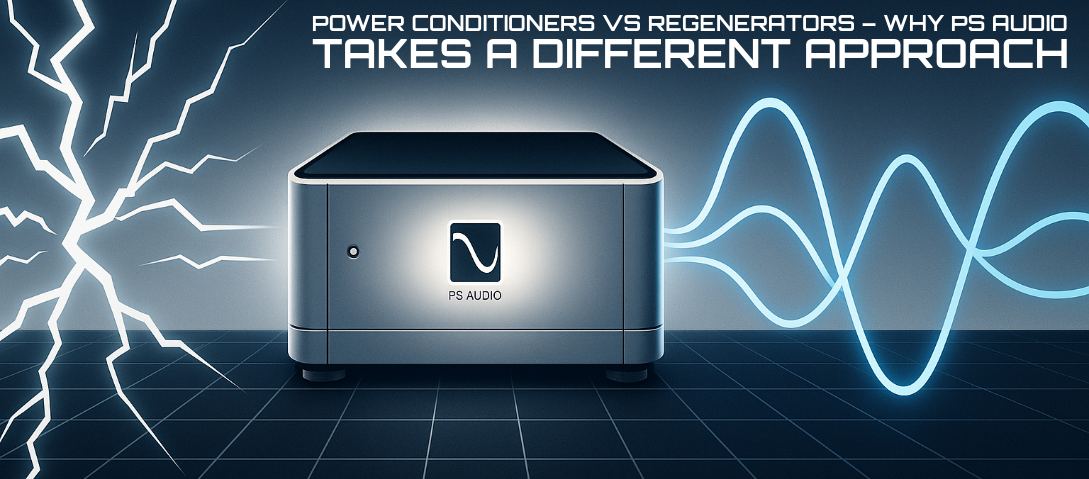
When it comes to powering your hi-fi system, clean electricity is just as important as the components themselves. Noise, distortion, and voltage fluctuations in your mains supply can mask fine detail, reduce dynamics, and limit the full potential of your system. This is where solutions like power conditioners and regenerators come in, but what's the difference, and why does PS Audio take a unique approach?
The Role of a Power Conditioner
Traditional power conditioners filter incoming electricity, removing some of the noise and interference picked up along the way. They often include surge protection and can be useful for basic system safety. However, filters alone can't fully address distortion in the AC waveform or fluctuations in voltage. In some cases, they can even limit current delivery to your equipment.
Why PS Audio Developed Power Regenerators
PS Audio recognised the limitations of conditioning and pioneered the use of mains regenerators. Instead of simply filtering power, regenerators completely rebuild the AC waveform. They take the incoming electricity, convert it to DC, and then regenerate a brand-new, perfectly regulated sine wave. The result is a consistent supply of clean, stable power that eliminates distortion and maintains full dynamic range.
If you are also considering how mains cables feed into this picture, our article on whether hi-fi mains power cables make a difference covers the interaction between cable quality, power supply, and system resolution in practical terms.
The Listening Benefits
With a PS Audio regenerator, music sounds more alive. Dynamics are greater, detail is clearer, and the noise floor drops dramatically. Instruments and vocals gain more natural presence, and long listening sessions become more engaging and fatigue-free. Crucially, because regenerators maintain steady voltage and unrestricted current, your equipment always performs at its best.
Which PS Audio Regenerator is Right for You?
For compact systems or front-end components, the PS Audio Stellar Power Plant 3 is a perfect entry point. Larger systems can benefit from more powerful models, ensuring all equipment receives regenerated power. Whichever you choose, you'll experience the difference of a system powered by electricity as pure as the music itself.
For a broader look at where power quality fits within a complete system upgrade, our hi-fi upgrade series overview covers power, grounding, cabling, vibration control, and room acoustics in a single structured guide.
PS Audio Regenerators: Comparison at a Glance
| Model | Best For | Key Features |
|---|---|---|
| Stellar Power Plant 3 | Smaller systems, DACs, preamps, streamers | Compact design, regenerated power for up to 300W continuous load |
| DirectStream Power Plant 12 | Mid-sized systems | 4 zones of regenerated power, touchscreen interface, up to 1250W peak |
| DirectStream Power Plant 15 | Larger hi-fi setups | Higher current delivery, multiple regenerated zones, up to 1500W continuous |
| DirectStream Power Plant 20 | Reference-level systems | Flagship regenerator, 2000W continuous output, ultimate stability and headroom |
Matching the Right Power Plant to Your System
The comparison table identifies each model by a broad system category. The more practical question is how to determine which model can handle your specific component combination, and what to do if budget only allows the Stellar PP3 for a larger system. Here is FutureShop's matching guide.
Calculating your system's continuous power draw. Every hi-fi component has a rated power consumption listed in its specifications, usually in watts. The total continuous draw of all components you intend to connect to the regenerator must be below the model's continuous output rating. A typical calculation for an integrated amplifier system might look like this: a 100W/channel integrated amplifier draws approximately 200 to 300W at moderate listening levels (not the rated output power, which is rarely sustained); a streamer draws 15 to 30W; a DAC draws 10 to 25W; a phono stage draws 10 to 20W. A total of four components in this configuration would draw approximately 250 to 375W under normal listening conditions, which sits at or above the Stellar Power Plant 3's 300W continuous rating. In practice, the PP3 handles this configuration comfortably for most listeners, because sustained maximum draw is rare during normal music playback. However, a system with a high-bias Class A integrated amplifier drawing 400W or more continuously should be connected to the DirectStream Power Plant 12 or above. If in doubt, check the power consumption specification in your amplifier's manual: it will be listed as a watt figure, not the output power rating.
Stellar Power Plant 3: source components and front-end priority. The most productive use of the Stellar Power Plant 3 in a system that exceeds its continuous load capacity is to connect the source components only and leave the amplifier on a separate quality power block. In any hi-fi system, the source components (DAC, streamer, phono stage, CD transport) are the most sensitive to mains noise and the components where regenerated power produces the most clearly audible improvement. The amplifier's robust internal power supply is less sensitive to incoming mains quality than a DAC's clock circuit or a phono stage's gain stage. This configuration delivers the primary benefit of regeneration where it matters most, while the amplifier's separate power supply handles its own noise filtering. Many FutureShop customers start with a Stellar PP3 for their front end and add a DirectStream Power Plant for the amplifier as a second step.
DirectStream Power Plant 12: full system coverage for most integrated amplifier systems. The PP12's 1250W peak capacity covers a complete system including an integrated amplifier, all source components, and a phono stage, in most listening scenarios. The PP12 adds a touchscreen interface that displays real-time mains distortion readings before and after regeneration, which is the most visually compelling demonstration of what the regenerator is doing: a typical domestic mains supply runs at 2 to 5% total harmonic distortion (THD), and the PP12 reduces this to below 0.1%. The four isolated zones within the PP12 separate digital source components from analogue components, preventing the digital switching noise that sources generate from contaminating the analogue supply feeding the amplifier. This is the feature that most differentiates the PP12 from the Stellar PP3 for full-system use.
DirectStream Power Plant 15 and PP20: separates systems and high-current amplifiers. In a separates system with a dedicated power amplifier, the power amplifier's continuous draw becomes the critical variable. A stereo power amplifier rated at 200W/channel may draw 400 to 600W continuously at moderate listening levels; Class A power amplifiers draw their maximum rated power at all times regardless of signal level. For separates systems, the PP15 (1500W continuous) and PP20 (2000W continuous) ensure the power amplifier receives the same regenerated supply as the source components, without the regenerator ever approaching its limit. Operating a regenerator at more than 80% of its continuous rating for extended periods is not recommended: headroom below the continuous limit maintains the quality of the regenerated sine wave and the longevity of the regenerator itself. The PP20 is the appropriate choice for monoblock amplifier configurations or where the total system draw approaches or exceeds 1000W.
A note on the power cable between the wall and the regenerator. The regenerator's incoming mains cable is the one power cable in a PS Audio system that directly affects regenerator performance. A quality power cable at this connection reduces the distortion the regenerator has to work with before regeneration begins, lowering its operating temperature and improving the quality of the output waveform. PS Audio supplies a quality cable with each Power Plant, but upgrading to a third-party cable with lower impedance and better shielding at the wall-to-regenerator connection is the most productive single cable upgrade in a PS Audio-based system. For guidance on which brands and models to consider, our Essential Guide to Mains Power covers the main power cable brands and their characteristics in detail.
The Stellar Power Plant 3 and the DirectStream Power Plant 20 are available now at FutureShop. Not sure which model suits your system? Get in touch with our team and we will help you find the right PS Audio regenerator for your setup and budget.