Our Verdict
Townshend Audio's Seismic isolation range addresses a problem that mass and rigidity alone cannot solve. By creating a true mechanical break between equipment and floor, the Pods, Platforms, Podiums, and Corners consistently deliver improvements in bass definition, midrange clarity, and soundstage width that many far more expensive component upgrades cannot match.
Quick Take
- Mechanical vibration from transformers, speaker output, and floor energy reaches sensitive circuits and driver assemblies, clouding detail and smearing imaging even in well-built systems.
- Heavy racks provide stability but do not prevent vibration transfer. Mass coupling without decoupling still allows resonance to travel into components.
- Townshend's approach creates a true mechanical break using floating isolation modules. The effect is immediate: tighter bass, more open midrange, and a wider, more three-dimensional soundstage.
- Seismic Pods: adjustable weight loading, suitable under individual components or loudspeakers. Seismic Platforms: wide support surface for turntables, DACs, and amplifiers. Podiums: dedicated floor-standing isolation for large or heavy speakers. Corners: converts an entire rack into an isolated platform.
- Listeners consistently report that Townshend isolation transforms their system more than many costly component upgrades, particularly in bass definition and soundstage depth.
Understanding the Problem: Resonance in Hi-Fi Systems
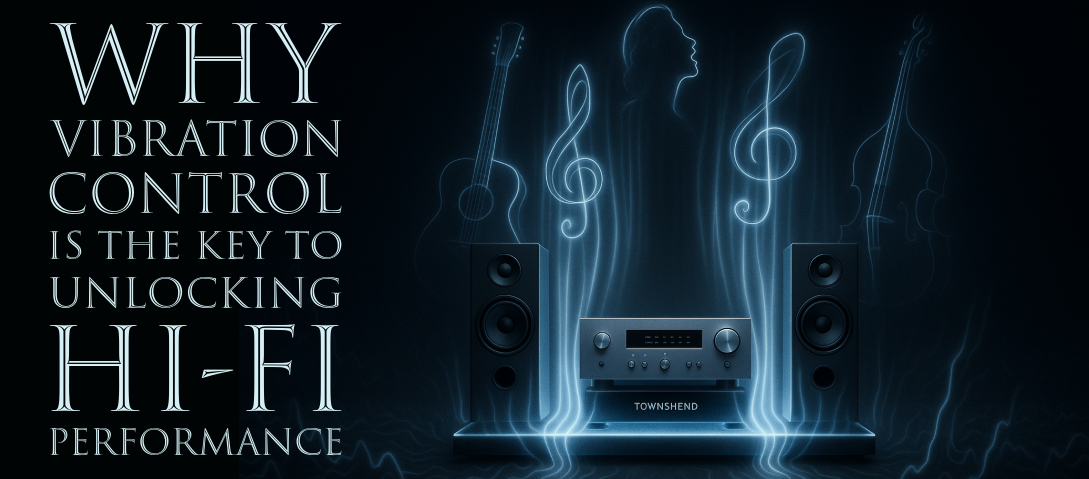
Every hi-fi system, no matter how carefully assembled, is vulnerable to one persistent problem: vibration. From the subtle hum of a transformer to the energy of sound waves travelling through your floor, mechanical vibration can find its way into your delicate components. This resonance clouds detail, smears imaging, and reduces the natural dynamics of music. Even high-end electronics and loudspeakers can fall short of their full potential when affected by vibration.
Why Traditional Racks Are Not Enough
Many enthusiasts rely on solid racks or heavy stands to support their equipment, assuming mass alone will control vibration. While these can provide stability, they rarely address the transfer of mechanical energy. Vibrations can still travel up through the rack and into your components, subtly degrading sound quality. The result is a system that looks secure but still suffers from a lack of clarity and focus.
The Townshend Approach to Isolation
Townshend Audio takes a different path. Their Seismic Isolation Platforms, Pods, Podiums, and Corners are engineered to decouple equipment and speakers from floor-borne energy. By creating a true mechanical break, they stop vibrations from reaching sensitive circuits and driver assemblies. The effect is immediate: tighter bass, a more open midrange, and a soundstage that feels wider and more three-dimensional.
Seismic Platforms and Pods in Action
- Seismic Isolation Platforms: Ideal for turntables, DACs, amplifiers, and other electronics. These platforms float your equipment on isolation modules that absorb vibration before it reaches the component.
- Seismic Isolation Pods: Flexible solutions that can be placed directly under loudspeakers or electronics. Adjustable to suit different weights, they provide a customised level of isolation.
Comparison of Townshend Isolation Products
| Product | Best For | Key Benefit |
|---|---|---|
| Seismic Isolation Pods | Individual components and speakers | Adjustable modules provide tailored isolation for different weights |
| Seismic Isolation Platforms | Turntables, DACs, amplifiers, CD players | Wide support surface with floating modules to absorb floor-borne vibration |
| Seismic Podiums | Loudspeakers and subwoofers | Dedicated floor-standing isolation system for heavy or large speakers |
| Seismic Corners | Full hi-fi racks or furniture | Converts an entire rack into an isolated platform by decoupling from the floor |
Which Product for Your System and Floor?
The table above identifies which Townshend product suits which broad component category. The more practical question is which specific product to choose based on your floor type, component weight, and whether you want to address a single component or the whole system at once. Here is FutureShop's matching guide.
Turntable on a suspended timber floor (the most demanding case): The Seismic Platform is the correct product. A suspended floor flexes under footfall at low frequencies: the platform's floating isolation modules are specifically designed to absorb this type of low-frequency transmission, which conventional isolation feet (including sorbothane and standard spring solutions) do not address effectively. The platform sits under the turntable on the rack shelf, and the turntable sits on the platform's top surface. For the most challenging suspended floor situations where rack-borne vibration is also a problem, adding Seismic Corners under the rack as well provides a two-stage solution: the Corners decouple the rack from the floor, and the Platform decouples the turntable from the rack shelf. This combination addresses vibration arriving from both the floor and from other components sharing the rack.
Floorstanding speakers on any floor type: The Seismic Podiums are the dedicated solution for floorstanding loudspeakers. The Podiums sit between the speaker cabinet and the floor, creating the mechanical break that prevents speaker energy from travelling into the floor and floor energy from travelling back into the cabinet. On hard floors, the Podiums are particularly effective at reducing the bass smearing that occurs when speaker energy excites the floor and re-enters the speaker through the cabinet base. On carpet, the Podiums provide a more stable platform than conventional spikes, which can rock on uneven carpet pile. The correct Podium size is determined by the speaker's footprint and weight: Townshend supply Podiums in different configurations for this reason.
Electronics (DAC, amplifier, streamer) on a rack shelf: The Seismic Pods are the most flexible solution for individual electronics. A set of three or four Pods placed under a component decouples it from the rack shelf and from the airborne vibration generated by nearby speakers. The weight loading of each Pod must be matched to the component's weight: Pods are available in different weight grades (light, medium, and heavy), and using the correct grade is essential for the isolation to work at the correct resonant frequency. An incorrectly loaded Pod that is under- or over-compressed does not isolate effectively. The DAC is the highest-priority component for Pod isolation in a digital system: clock circuit sensitivity to vibration is well documented, and even modest improvements in isolation at the DAC produce an audible reduction in jitter-related artefacts.
Converting an existing rack into an isolated system: The Seismic Corners are the most cost-effective way to isolate all components on a rack simultaneously. A pack of four Corners fits under the four corners of any rack, lifting it from the floor on Townshend's isolation modules. Every component on the rack then benefits from the floor isolation, without needing individual Pods under each piece of equipment. The Corners are particularly useful where the rack is on a suspended floor and footfall is audible through the system: a single set of four Corners addresses the floor-to-rack vibration path for the entire system in one purchase. The limitation of Corners alone is that they do not address rack-to-shelf or airborne vibration between components: for systems where turntable isolation or individual component isolation is also needed, Corners are the first step and Pods or a Platform address the remaining vibration paths.
Standmount speakers on speaker stands: The Seismic Pods can also be used under speaker stands on hard floors, where they address the stand-to-floor vibration path. This is a productive application on hard wooden or stone floors where spikes would otherwise couple the stand rigidly to the floor surface. The weight rating of the Pods must account for the combined weight of the speaker and stand. For standmount speakers, Pods under the stand are typically more productive than Pods between the speaker cabinet and the stand top-plate, because the primary vibration path in a standmount system is through the stand legs into the floor and back up through the cabinet.
The Result: Greater Musical Insight
Listeners consistently report that adding Townshend isolation transforms their system more than many costly upgrades. By lowering the noise floor and reducing resonance, music gains natural flow, increased detail, and emotional impact. Instruments sound more lifelike, vocals more intimate, and recordings reveal depth that was previously masked.
The Hidden Upgrade That Changes Everything
Vibration control may not be as glamorous as a new amplifier or loudspeaker, but it is one of the most effective ways to improve system performance. With solutions like Townshend's Seismic Isolation Pods, Platforms, Podiums, and Corners, you can finally hear what your system is truly capable of delivering, an experience that feels closer to the live performance.
For a broader look at vibration control as part of a complete system upgrade, our Upgrading Your Hi-Fi: Part 6 Vibration and Support guide covers racks, isolation feet, and speaker stability across all price points. If speaker isolation specifically interests you, our IsoAcoustics GAIA Neo review looks at a complementary approach to decoupling speakers from the floor.
Browse the full range of Townshend Audio isolation products, including Seismic Pods, Platforms, Podiums, and Corners. Not sure which solution suits your system? Get in touch with our team for free expert advice.